Switching careers is never an easy decision, especially when you already have a stable job and financial responsibilities. Many working engineers from IT, ECE, EEE, and even non-core backgrounds often think about moving into the semiconductor industry but hesitate due to the fear of uncertainty. The good news is that with the right approach, you can transition smoothly into VLSI without putting your current career at risk.
The demand for skilled engineers in the semiconductor sector is growing rapidly. With increasing Semiconductor job opportunities in India, companies are actively looking for trained professionals in design, verification, and physical implementation roles. This makes it the right time for working professionals to consider a structured and safe shift through a well-planned Semiconductor career transition course.
Why Professionals Are Choosing VLSI as Their Next Career Move
Many professionals feel limited in growth in their current roles. Some work in software support, some in testing, and others in hardware maintenance roles with limited exposure to advanced design technologies. Over time, this lack of technical depth leads to stagnation.
The VLSI industry, on the other hand, offers structured growth, strong salary progression, and global project exposure. A well-designed VLSI course for working professionals allows engineers to upgrade their skills without quitting their jobs. Instead of taking a risky jump, professionals can prepare step-by-step while maintaining financial stability.
The semiconductor industry rewards skill and specialisation. Once you enter the field with the right knowledge and hands-on exposure, long-term career growth becomes much more stable compared to many other domains.
Reducing Career Risk with Proper Planning
The greatest error that professionals commit is quitting their jobs and later joining training. This puts unwarranted pressure and urgency. The more intelligent solution is to take a Industry oriented VLSI training program, which provides flexible programs, weekend-based programs, or online programs.
Working on the job at the same time as you study minimises the risk of money and builds confidence over time. After you have gone through your training and feel technically strong, you can start a the job application. When there is decent training in VLSI with placement assistance, transitioning will be more organized and fixed.
An excellent training program is one that ensures you are in shape to face an interview before venturing into the job market.
Selecting the Specialization that will make the transition process smoother.
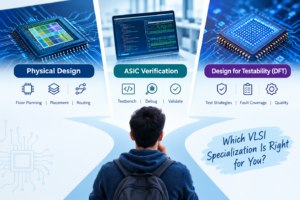
VLSI is a field that provides several career opportunities, and it is essential that working professionals choose the correct one. You should specialise in something that you like and that you can learn, as compared to learning everything.
As an example, the Physical design course among professionals is most appropriate to engineers seeking to work in backends on chip implementation. Physical design jobs include floor planning, location, routing, timing closure and chip optimisation. Such positions are sought after in semiconductor firms.
Alternatively, a job in verification may also be viewed as an option by professionals possessing programming knowledge. In any direction you go, it is important to be structured and focused in learning.
The Reason for Job-Oriented Training.
In changing the fields, it does not suffice to change the theoretical knowledge. Business firms desire to have hands-on exposure to tools and actual project knowledge. A job-oriented VLSI course is one that is industry-oriented.
Such programs include:
- Tool-based hands-on training
- Real-time project work
- Resume preparation
- Mock technical interviews
- HR interview guidance
This is a viable strategy that will go a long way towards enhancing your self-confidence in an interview. Together with VLSI certification of working engineers, it enhances your career image and assures the recruiter that you can change domains.
Dynamics of Semiconductors in India.
India is fast emerging as a semiconductor design centre of the world. The market segment of experienced VLSI engineers is growing annually with the growth of investments and new research and development facilities. This expansion is generating long-term Indian Semiconductor employment, particularly in the metro cities such as Bangalore and Hyderabad.
Those professionals who switch now will be able to establish themselves and develop well in the next few years. The semiconductor field is not a fad; it is a long-term and high-tech industry that has international applicability.
Significance of the choice of the best institute.
The way and place you learn are mostly determinants of your success. The best VLSI institute in Bangalore must also offer alternative training specifically for working professionals. It is supposed to provide access to experienced trainers of the industry, access to tools, practical projects, and good placement assistance.
In the absence of reputable guidance, most professionals have difficulty learning about the interview expectations of the semiconductor firms. Formatted VLSI education combined with placement help seals the divide and trains you in a well-organised manner.

Switching among working professionals in Takshila VLSI.
As an engineer with plans for a safe, planned transition, Takshila VLSI offers career-switcher programs. The institute offers flexible schedules, weekend and online batches, and practical exposures in accordance with industry standards.
Takshila VLSI is dedicated to industry-oriented VLSI education, and hence, the working professionals of the company receive project exposure in real time as opposed to mere theoretical knowledge. Their Professional Physical Design course is designed in such a way that it is aligned with the modern industry needs, which assists the candidates in gaining confidence through a gradual process.
The institute also offers professional VLSI training for students, which includes placement training, interview training, resume construction, and career counselling. There is also the known VLSI certification of working engineers to professionals, which makes the profile of professionals stronger when they are seeking jobs in semiconductors.
Conclusion
However, the transition to VLSI need not be risky in case it is properly done. Speed is a matter of tactics but not strategy. Get started at your job, take a structured VLSI course as a working person, emphasise practical training, get certified, and start job applications when you are prepared.
As Semiconductor employment in India is on the increase, this is the appropriate moment to invest in skills training. A properly designed job-oriented VLSI course and good placement support can ensure that the transition is successful and smooth.
If you are willing to jump to a stable and high-growth semiconductor career, begin your career with Takshila VLSI and make the first sure step towards achieving your future in the VLSI field.