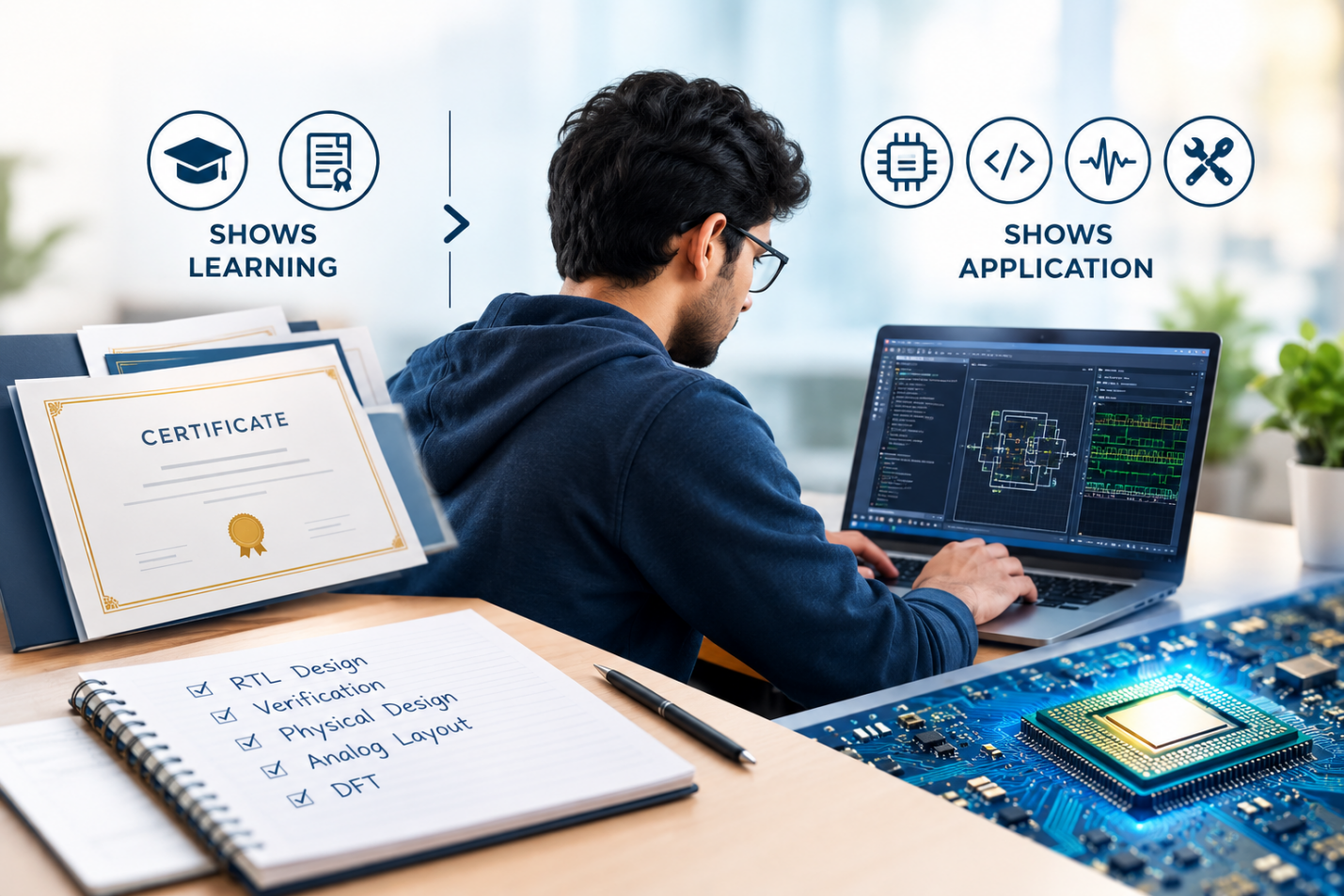
The semiconductor industry isn’t looking for paper knowledge or merely the names of training courses you attended. While certifications confirm completion of the curriculum, a candidate’s hands-on experience reflects their aptitude to effectively use this learned information. Therefore, VLSI projects for resume are invaluable for students and graduates wishing to foray into chip design. The potential to showcase hands-on proficiency, problem-solving talents, and comprehension of industry-standard VLSI design pipelines can make for a formidable collection of work.
Certificates Show Learning, Projects Show Application
It shows that you did analog layout training, a physical design course, an ASIC verification program, or any other technical course. But recruiters also want to know how well you are going to use the course skills.
You can showcase your familiarity with design methodologies, EDA tools, verification approaches, and project needs with realistic VLSI resume projects, and thus make knowledge into tangible working know-how. Projects, for beginners with zero or little to negligible to real-time working, would turn into a significant section of their resume.
How VLSI Projects Strengthen Your Resume
If your VLSI practical projects are properly done, they can add a lot of value to your resume and showcase your technical strengths. Simply listing that you know Verilog, SystemVerilog, UVM, Physical design, and analog layout would not be impactful. Here, you need to show how you actually implemented and used these technologies.
These might consist of, for example, your projects section, such as:
- RTL design and FPGA implementation
- ASIC verification projects
- Physical design flow assignments
- Analog or custom layout assignments
- Design for test implementation
- Timing analysis and verification assignments
The chip design project work helps employers figure out the practical exposure, skill set, and technical inclination you have.
Choosing the Right VLSI Project Ideas
The kind of best VLSI project ideas depend on the specialization you pick up and the level of expertise you have. In case you are a beginner, try the formal VLSI projects first, understand and implement them, and then try to improvise by building them for high performance and more features.
Students interested in verification can take RTL verification environment development; on the other hand, students interested in physical design can do routing and timing-based designs. Analog layout students would learn to work on layout implementation and layout verification.
Why Practical Experience Matters for Freshers
It can be hard for newbies who’re aiming to make their career in the semiconductor industry by virtue of just educational knowledge. Here are VLSI projects for freshers, which provide an ideal way to bridge the existing differences.
Projects for learning at hands are able to:
- Gain more confidence when working with new technologies
- Familiarize you with a real design workflow
- Strengthen problem-solving skills
- Prepare you for technical interviews
- Create a great portfolio with real skills
Working on semiconductor projects for students also provides applicants with helpful examples to talk about in their interviews. Showing the process by which you resolved technical difficulties may help you to explain how well you grasp concepts better than listing a piece of paper would allow you to do.
Build a Strong VLSI Portfolio for Jobs
For a VLSI career portfolio, you must display your engineering tasks, equipment, duties and important learning outcomes distinctly. Make sure you provide all relevant information.
With each project, detail the following;
- Project goal
- Tools and technologies used
- Your personal involvement
- Technical theories used
- Results/ learnings
Learn Through Training and Practical Exposure
The best approach to secure a career in VLSI is a blend of theoretical understanding with practical experience. At Takshila VLSI, we are committed to nurturing students into becoming industry-ready by incorporating practical laboratories, relevant projects, expert trainers, and specialized programs in physical design, ASIC verification, analog layout design, DFT, analog circuit design, and RTL coding.
Conclusion
Even though certificates help boost your resume, it’s the practical implementation that eases the demonstration of your skills. Developing relevant, substantial VLSI projects for resume enhancement is one great way to allow future engineers to explain what they’ve learned and how they can use it.
The students at Takshila VLSI focus on building a technically strong foundation using a practical approach with hands-on sessions, industry exposures, training with focus on the required skills, and practical-based learning/projects, which allows young engineers to gain experience, enhance their profile, and feel confident preparing for upcoming new ventures within the booming semiconductor industry.