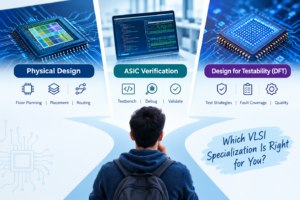
Have you ever asked yourself who ensures that complex chips that power smartphones, cars, and data centres function correctly before they enter the market? When you like solving problems, logic, and getting technical, an ASIC Verification career is rewarding. As the complexity of semiconductor designs grows, verification is now one of the most urgent and sought-after jobs in the VLSI design sector. This guide will examine the ASIC Verification career roadmap, on-the-job roles, required skills, and why this field is a long-term, stable career path for both novice and expert engineers.
What’s an ASIC Verification Career?
An ASIC Verification career aims to ensure the intended functionality of a chip design before fabrication. Verification engineers develop the test environment, write the verification code, and isolate functional bugs early, saving companies significant money. Verification now accounts for nearly 60% of the overall chip development time, making ASIC Verification career opportunities as robust as ever.
Startups and the largest semiconductor corporations worldwide must rely on qualified verification engineers to ensure reliability, performance, and compliance.

Why ASIC Verification Is Critical in VLSI Design
ASIC designs are becoming more complex with advanced nodes, SoCs, and AI accelerators. This complexity directly fuels ASIC Verification career opportunities worldwide. A strong ASIC Verification career exists because even a small functional error can cause millions in losses post-fabrication.
Key reasons verification is indispensable:
- Rising chip complexity and integration
- Zero-defect requirements in automotive and medical chips
- Increased adoption of reusable verification frameworks
- Growing use of Advanced ASIC Verification techniques
ASIC Verification Career Roadmap: Step-by-Step Growth
A clear ASIC Verification career roadmap helps candidates plan their journey effectively.
Entry Level (0–2 Years)
This stage suits an ASIC Verification career for freshers who start by learning:
- Digital design fundamentals
- SystemVerilog and UVM basics
- Simulation and debugging skills
Enrolling in a structured ASIC Verification course for engineers accelerates this phase.
Mid Level (2–5 Years)
At this stage, engineers deepen expertise in:
- UVM-based testbench architecture
- Coverage-driven verification
- Assertion-based verification
This phase opens stronger ASIC Verification career opportunities and leadership roles.
Senior Level (5+ Years)
Senior engineers work on:
- Verification strategy and planning
- Advanced protocols and SoC-level verification
- Mentoring teams and defining best practices
A mature ASIC Verification career roadmap often leads to roles like Verification Lead or Architect.
ASIC Verification Careers for Freshers: How to Start Strong
An ASIC Verification career for freshers is very feasible with proper preparation. Companies are more interested in candidates who have solid fundamentals, practical laboratory experience, and exposure to projects.
Key steps include:
- Passing a concentrated ASIC Verification course as an engineer.
- Testbench development: practical experience.
- Verifying learning tools in the industry.
The selection of reputable ASIC Verification training institutes helped close the gap between academia and industry.
ASIC Verification Career Opportunities in India
India has emerged as a global semiconductor talent centre. There are numerous ASIC Verification job opportunities in India for both product and service businesses. With the emergence of additional fabs and design centres, career opportunities in ASIC verification are increasing.
Engineers with strong verification proficiency typically enjoy greater job security and more competitive salaries than those in other VLSI fields.

Advanced Skills That Boost Your ASIC Verification Career
To remain relevant, engineers need to learn Advanced ASIC Verification techniques, including
- Limited random verification.
- Engineers need to master advanced techniques such as limited random verification and capital coverage closure.
- Formal verification and low power.
Such competencies are an essential boost to an ASIC Verification career and sustained employability.
Building Your ASIC Verification Career with the Right Guidance
A practical ASIC Verification career roadmap relies not just on learning tools but also on mentorship and field experience. Universities such as Takshila VLSI assist future engineers with industry-relevant programs, practical laboratories, and structured curricula. The right training environment can help ambition become a sustainable, rewarding career for those seeking to join or advance in ASIC verification.