An excellent path for engineering graduates to enter the semiconductor industry in 2026 is to start as a VLSI engineer. As the number of chip designers, AI, and electronic producers rapidly grows, more than ever before, the entry routes of freshers are well organised and practical. The decision on the best VLSI courses for freshers in India is not just about learning theory but also about acquiring industry-relevant skills that qualify them to enter the labor market. The designed program focuses on tools, practical projects, and employment preparation. The current industry requires individuals who have been trained through job oriented VLSI training for beginners, whereby the learning process is charted from the rudimentary level to sophisticated design principles.
Understanding the VLSI Learning Roadmap from Zero to Job-Ready
The VLSI career path starts with a solid foundation and progresses to specialized fields such as physical design or verification. Knowing the complete VLSI learning path for freshers allows the freshmen to avoid confusion and thus remain career outcomes-focused.
A beginner should first understand digital electronics, semiconductor basics, and HDL concepts before choosing a specialization. This clarity helps answer how to start a career in VLSI after engineering without wasting time on irrelevant topics.
- Start with the basics of electronics, CMOS technology, and logic design
- Learn Verilog or SystemVerilog as core HDL languages
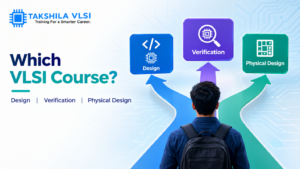
- Move to domain-specific training, like physical design or verification
- Practice real-time projects to build industry-ready confidence
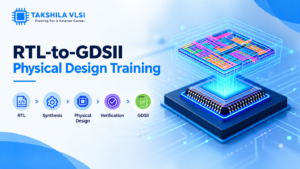
- Understand the chip design flow from RTL to GDSII
Core VLSI Courses Every Fresher Should Explore
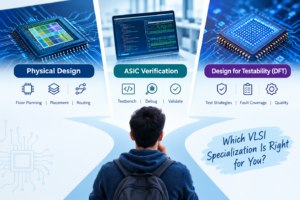
To develop a good career foundation, freshers have to select courses that are relevant to real jobs in the industry. The most valuable programs include Physical Design, Analog Layout Design, ASIC Verification, Analog Circuit Design, and Design for Test. These courses are part of beginner friendly VLSI training programs designed to match hiring requirements.
Each course focuses on a different segment of chip design, making it easier for students to specialize based on interest and aptitude.
- Physical Design -Emphasizes chip implementation and layout optimization.
- Analog Layout Design: This is the transistor-level layout and precision design.
- ASIC Verification – Make sure it is functional using simulation tools.
- Analog Circuit Design – Discusses tuning circuit behavior and performance.
- Design for Test (DFT)- Prepares the chips to be tested and faults are detected.
Course Structure, Duration, and What You Will Learn
The VLSI programs would be well-established and last 4-8 months, depending on the specialization and mode of learning. Knowledge VLSI course duration fees and syllabus assist the students to organize the time and investment productively.
The courses are made to balance between theory and practical application in that the students would be certain in addressing real-world projects. Flexible learning now also has an online VLSI course with certification options in many institutions.
- Duration ranges from short-term modules to full career programs
- Includes tool-based training on industry-standard software
- Covers RTL design, verification, layout, and testing concepts
- Hands-on labs and assignments for practical exposure
- Certification and project work to strengthen resumes
Why Practical Training Matters More Than Theory
Theoretical information cannot be used in VLSI. Companies seek candidates able to solve real chip design problems. This is why job oriented VLSI training for beginners is very real in learning.
An effective training strategy fills the gap between book knowledge and industry requirements. It also opens the prospect of joining a VLSI course with placement support in India, which connects students with recruiters.
- Problem-solving skills are enhanced through exposure to the project in real time.
- Tool-based learning equips the students with future job positions.
- Mock interviews and resume assistance enhance confidence.
- Case studies in industry help clarify the real problem.
- Internships augment real experience.
Career Opportunities After Completing VLSI Training
The semiconductor sector provides different opportunities to freshers according to their specialization. Properly trained students will be able to open up several VLSI job opportunities for freshers in the fields of design, verification, and testing.
There is increasing demand for electronics, AI, automotive chips, and communication technologies, which is boosting the need for professional services. Identifying the appropriate VLSI training institute for freshers is important in tapping such opportunities.
- Physical Design Engineer – Chip layout and optimization.
- Verification Engineer – Tests with simulation tools.
- Analog Design Engineer- designs high-performance circuits.
- DFT Engineer – Grants chip testability and fault coverage.
- FPGA/RTL Engineer- It creates and tests digital designs.
Choosing the Right Training Approach in 2026
Choosing the appropriate training institute is a serious choice for freshers. The most effective are those that are industry-aligned, expert-oriented, and career-oriented. A quality institute offering the best VLSI courses for freshers in India will equip students with both technical and practical knowledge.
The learning context must be oriented toward novices and take them through the complete VLSI learning path for freshers.
- Find trainers who have industry experience.
- Check course material: new tools, technologies.
- Placement assistance programs should be available.
- Favored institutes with live projects and mentorship.
- Assess flexibility, e.g., online and offline training formats.
Building a Strong Foundation for Long-Term Growth
A good VLSI career is not merely the first job but a lifelong learning and development. Freshers must first learn the basics and gradually enhance their skills through advanced courses.
Courses like VLSI courses with placement support in India ease students into the industry and prepare them for a long-term career.
- Continue studying new skills and new technology.
- Keeping abreast with trends in the semiconductor industry.
- Build your portfolio on individual projects.
- Build a powerful professional network in the industry.
- Learn to think critically and resolve issues.
Conclusion
To be a VLSI in 2026, it would require the right mixture of formal education, on-the-job training and internship in the industry. The freshers can pursue and retain the high-growth semiconductor jobs of Physical Design, ASIC Verification, Analog Circuit Design and Design for Test. A key difference for future success is choosing a training platform that focuses on real-time tools, project-based learning, and career readiness. Takshila VLSI is a reputable learning center where beginners can ease their way into academic knowledge to reach industry level and begin and develop a successful VLSI career.