Electronics and Communication Engineering (ECE) is a rapidly changing field with the emergence of semiconductor technologies, embedded systems, AI hardware, and chip manufacturing. With students planning on where to work in the future, the most used question in debate is which is better core electronics or VLSI?”
The Indian semiconductor industry is growing at a rapid rate in 2026 as the government invests in the industry, the world needs more chips, and the industry establishes new fabrication and design facilities. Due to this expansion, it is now necessary to understand the distinction between VLSI and electronics career opportunities to enable students to plan their future.
This blog will assist you to compare the two fields, know about employment, earnings, and competencies, and find the most optimal career choice after ECE.
Understanding Core Electronics
Core electronics is a general branch of engineering, which deals with electronic circuits, communication, embedded systems, instrumentation, power electronics, and hardware devices. Industries that students in this direction tend to work in are commonly manufacturing, automation, telecommunications, robotics, and consumer electronics.
Core electronics: Some typical careers in hardware engineering are:
- Embedded Systems Engineer
- PCB Design Engineer
- Communication Engineer
- Automation Engineer
- Power Electronics Engineer
- Hardware Testing Engineer
One of the best areas for ECE graduates has always been core electronics. Electronics engineers are still employed by many companies operating in the public sector and in manufacturing industries as technical and operational engineers.
But the nature of electronics jobs India is transforming. Firms are now favoring engineers who are skilled in software integration and are also well versed in hardware.
What is VLSI?
VLSI means Very Large Scale Integration, this term is used when talking about the design and fabrication of an Integrated circuit or semiconductor chip. This way, high complex electronic functions can be ‘downloaded’ onto a small chip and these can be found in devices like smart phones, laptops, electronic devices inside cars, electronic devices used in medicine, Artificial Intelligence etc.
One of the most rapidly expanding areas among ECE students career options in India 2026 has been VLSI due to the high investments by semiconductor firms in chip design and verification.
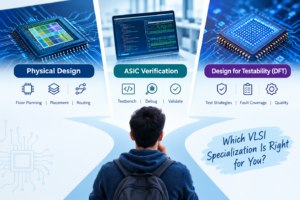
Some key VLSI areas are:
- Physical Design (PD)
- ASIC Verification
- Design for Test (DFT)
- RTL Design
- Analog Layout Design
- Analog Circuit Design
- FPGA Design
VLSI has become one of the most appealing career choices of ECE graduates due to the increasing demand of semiconductor talent.
Why VLSI is Gaining Popularity in India
The VLSI sector has been greatly enhanced by the semiconductor mission and the international investments of India. The companies are recruiting engineers who are trained in chip design, verification, physical design, and analog layout.
The growing needs of AI processors, automotive chips, and IoT devices have increased the prospects of VLSI engineers. This is the reason why VLSI is taken as one of the best career choices after ECE by many experts.
The benefits of VLSI are:
- High-paying technical roles
- Strong international demand
- Semiconductor giant opportunities.
- Contact with hi-tech technologies.
- Faster career growth
Among students considering long-term expansion, the controversy of which has been better core electronics or VLSI, tends to favor VLSI due to its future-proof characteristics.
Who Should Choose Core Electronics?
Core electronics may be a better choice if you:
- Enjoy hardware troubleshooting
- Like working with embedded systems
- Prefer field-based engineering roles
- Want opportunities in PSU sectors
- Are interested in robotics or automation
Core electronics still offers excellent hardware engineering careers, especially for students passionate about physical systems and devices.
Career Scope and Salary Comparison
Salary increment and industry demand are two of the largest factors that cause students to compare chip design vs core electronics.
In manufacturing and embedded systems, core electronics positions have had consistent growth, particularly within manufacturing. Nevertheless, VLSI professionals usually have higher salary packages because of the expertise involved.
Another commonly offered opportunity in semiconductor firms is to Freshers in VLSI fields like Physical Design, ASIC Verification and Analog Layout Design. Skilled individuals are able to transfer into luxury chip architecture and design.
With India emerging as a world hub in semiconductors, electronics jobs India are now taking a turn in favor of VLSI and semiconductor-based technologies.
Conclusion
The decision to go with core electronics or VLSI is not one between doing what is easy to do and what is not. Both areas provide invigorating prospects to ECE graduates. Nonetheless, VLSI is now a very promising specialty, boasting a good career progression and demand in the industry in the era of semiconductors.
At Takshila VLSI, students get industry-based training on Physical Design, ASIC Verification, DFT, Analog Layout Design, RTL Coding and Analog Circuit Design in programs, hands-on laboratories and projects. Takshila provides 24/7 tool access, mock interviews, and placement assistance to enable students to develop real-world VLSI skills and prepare to take part in a successful career in the VLSI industry.
Still not chosen between core electronics and VLSI, the most effective way is to analyze what interests you, what you want to achieve following your career and which technologies you want to deal with in the future. As the semiconductor industry continues to blossom, VLSI is emerging as one of the most promising and future-oriented career options among ECE graduates in India.
FAQ
1. What is the difference between core electronics and VLSI?
Core electronics focuses on hardware systems, while VLSI specializes in semiconductor chip design and integrated circuits.
2. Which is better for ECE students: Core Electronics or VLSI?
Both offer good career opportunities, but VLSI is growing rapidly due to increasing demand in the semiconductor industry.
3. Why is VLSI becoming popular in India?
Government initiatives and expanding semiconductor companies are creating strong demand for skilled VLSI engineers.
4. What career opportunities are available in VLSI?
VLSI offers roles such as Physical Design Engineer, ASIC Verification Engineer, RTL Designer, DFT Engineer, and FPGA Engineer.
5. Who should choose a career in core electronics?
Students interested in embedded systems, automation, hardware design, and electronics hardware can choose core electronics.
6. Is VLSI a good career for ECE graduates?
Yes, VLSI offers excellent career growth, competitive salaries, and opportunities with leading semiconductor companies.
7. What skills are required for a career in VLSI?
Knowledge of RTL Design, ASIC Verification, Physical Design, FPGA, and semiconductor fundamentals is highly valuable.
8. Which field offers better salary growth: Core Electronics or VLSI?
VLSI professionals often receive higher salary packages due to the specialized skills required in chip design.
9. Can fresh ECE graduates start a career in VLSI?
Yes, with proper VLSI training and practical experience, fresh graduates can begin careers in the semiconductor industry.
10. How can ECE students prepare for a VLSI career?
Students can join industry-oriented VLSI training programs that provide hands-on projects, tool-based learning, and placement support.