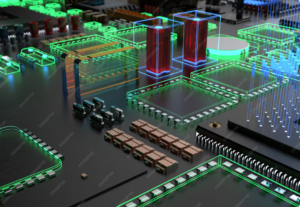
Designing an efficient chip begins long before routing or timing closure, the real foundation starts with smart floor planning. The difference between some of the performance, power, and area of chips can be in the quality of the floor plan structure, and often, you can wonder why certain chips perform better. In the modern semiconductor world, where velocity and density keep rising, engineers are required to master current VLSI floor planning methods to create sound and quick systems. This guide makes it a lot easier for a beginner and provides more useful information to professionals involved in working on more complex-looking VLSI physical design projects.
What Is Floor planning in VLSI?
At its core, Floor planning in VLSI is the stage where the placement of major functional blocks, memories, IOs, power structures, and routing channels is defined. It serves as the blueprint for the rest of the VLSI design flow, affecting timing, congestion, area, and manufacturability. Without an effective floor plan, even the best algorithms cannot fix structural inefficiencies later in the design cycle.
This step becomes even more critical as today’s chips incorporate thousands of blocks, requiring engineers to balance performance and physical constraints in innovative ways.
Why Floor planning Matters in VLSI Physical Design
Floor planning influences virtually all activities in the downstream of VLSI physical design. A floor plan guarantees the best wire length, minimal delays, high performance, and minimal routing problems. Ineffective planning results in congestion, IR drop, thermal hotspots, and missed tape-out deadlines, on the other hand. It is the reason that present-day teams are majorly dependent on structured VLSI floor planning techniques as a method of ensuring predictable silicon outcomes.
The purpose of Floor planning in VLSI is not just placement, but makes the key strategic decisions that affect the success of the overall VLSI design flow.
Key Objectives of Professional Floor planning
- Assuring block alignment and maximal spacing.
- Proximate logical proximity between similar IPs.
- To make a feasible aspect ratio and utilization in VLSI.
- Allocating metal layers to power and clock distribution.
- Minimizing intersects and routing barriers.
- Planning repeater and buffer insertion sites.
All these are contributions to performance and physical feasibility.
Important Floor planning Techniques Used in VLSI
- Block-Level Floor planning
Modern SoCs contain multiple functional modules. Effective block-level floor planning simplifies power routing, signal integrity, and timing closure. Grouping blocks based on connectivity reduces delays, while spreading high-switching blocks avoids thermal spikes.
- Managing Aspect Ratio & Utilization
The chip’s shape directly influences routing density and timing. Engineers carefully analyze aspect ratio and utilization in VLSI to avoid excessive whitespace or overcrowded areas that lead to performance penalties.
- Congestion Analysis
One of the largest challenges in the current dense designs today is routing congestion. Early congestion analysis in VLSI is useful to name the hotspots so that the designers can update the location of blocks and the spacing to ensure routing flexibility.
- Power Planning & IR Drop Prevention
A stable power grid is required in terms of stable chip performance. Sound power planning in physical design offers the correct separation of VDD and VSS lines, which removes the issue of droop and noise across the die. This step will be designed with power rings, straps, and taps.
Each of these methods supports the broader purpose of VLSI floor planning techniques, to build a layout that maximizes efficiency and minimizes risk.
How Floor planning fits into the Overall VLSI Design Flow
No successful chip is built without a structured VLSI design flow. Floor planning integrates tightly with placement, CTS, routing, STA, and signoff. Whether you are optimizing for area, timing, or manufacturability, the floor plan sets the baseline for every later stage of VLSI physical design. That is why engineers often revisit floor planning in VLSI multiple times to refine block positions and strengthen design robustness.
Best Practices for High-Quality Floor planning
Place large blocks closer together to minimize latency.
- Keep macros close to the edges so that they may be accessed easily.
- Apply halos and keep-out areas around the sensitive areas.
- After every pass of placement, re-analyze the congestion analysis in VLSI.
- Make sure that there is solid power planning in physical design to minimize IR drop.
- Ensure scalability in case of design changes.
Proper planning gives an easy route, timing and sign-off.
Conclusion: Why Floor planning Is Essential in VLSI
Floor planning is not just an early step; it is the backbone of the entire chip design. With strong VLSI floor planning techniques, optimized block placement, solid power grids, and predictable congestion control, engineers can build high-performance chips with fewer iterations and better silicon results. As VLSI physical design becomes increasingly complex, mastering this stage becomes crucial for anyone pursuing a future in semiconductor engineering.
For professionals looking to build real-world skills in these areas, Takshila VLSI offers industry-driven training that covers everything from floor planning in VLSI to the complete VLSI design flow, helping learners become job-ready for the fast-growing VLSI market.