The semiconductor industry is growing at a phenomenal rate, and that is why we have thousands of opportunities for young engineers. Most of the engineers fresh out of college are not able to get placement, as most companies are looking for candidates with practical knowledge in the field. VLSI certification courses help these engineers in gaining an upper hand when they step out into the industry, thus making them industry-ready.
For engineering graduates aiming for a career in Chip Design, chip Verification, chip testing or the chip manufacturing industry, a professional certification can tremendously enhance their placement chances and pave the way for the best of high-growth career opportunities.
Why Freshers Need VLSI Certification
While the education imparted at engineering colleges is extensive in theory, semiconductor companies require employees to have hands-on experience in industry-standard tools, design methodology and project flow. A fresher’s VLSI certification enables students to gain hands-on experience lacking in conventional academic curricula.
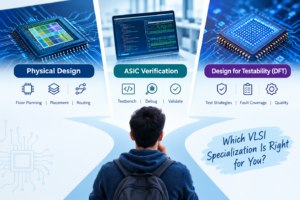
The certification courses enable individuals to be well-versed in concepts such as Physical design, ASIC Verification, RTL coding, FPGA design, Analogue layout design and Design for Testability (DFT), thereby making them suitable for professional roles within the semiconductor sector.
This certification signifies dedication to developing relevant skills and a willingness to continuously learn, thus attracting prospective employers to a candidate during placement.
Industry-Relevant Skills That Enhance Employability
One of the major strengths of Semiconductor certification courses is that they are highly practical. A contemporary semiconductor organization would require engineers who work with sophisticated Electronic Design Automation (EDA) tools, are familiar with end-to-end chip design flow and so on.
The quality certification programs offer the following:
- Real laboratory exercises
- Real industry-relevant projects
- Exposure to state-of-the-art EDA tools
- Mock interviews and tests
- Practical problem-solving experience
This helps a fresher to build his/her confidence and acquire the skills that are expected by the industry, and thus candidates become efficient and ready for technical interviews and work.
Specialized Certifications Increase Career Opportunities
In the VLSI industry, there are various streams available for you to specialize. As a Fresher, you can go in for certifications based on your inclination and aspirations.
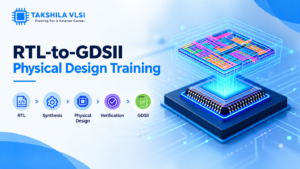
For example, taking up an online Physical Design certification course, you will gain knowledge about floorplanning, placement, clock tree synthesis, routing, timing analysis and physical verification. A Physical design engineer has great demand as ICs are getting more complex day by day.
Likewise, taking an ASIC verification certification course, one would be trained to verify the function of an IC before it is produced. This is very crucial, and a verification engineer ensures that the design is fault-free and robust, making it a more desirable specialization in the semiconductor domain.
Choosing the appropriate certification, you can narrow down your target jobs and get interviews from the top-notch semiconductor firms.
Job-Oriented Training Makes a Difference
Companies often want people who can add value immediately from the first day. As a result of this need for ready engineers, there is a high demand for job-oriented VLSI certification courses among the fresh graduates. These courses are different from the conventional training courses because they are tailored to industry needs and are mainly centred on:
- Practical project work
- Industry-specific methodology
- Tool-based learning
- Technical interview preparation
- Resume building
- Placement support
These courses inculcate both technical and soft skills in students for better career prospects in the semiconductor industry. The institutes also hold dummy interview sessions and mock interviews to allow the student to analyze their strengths and prepare for their future interviews.
Placement Support Adds Additional Value
Training quality matters, but placement assistance is an added advantage that has a substantial impact on your career. When opting for a reputed VLSI institute in Hyderabad which offers placement assistance, you will get access to hiring networks, corporate tie-ups and placement aid.
In institutes where they team up with semiconductor firms, recruitment drives, technical workshops, and counseling for career development are being carried out regularly by organizations. This helps students to get acquainted with prospective employers and boost up their chances of getting job offers after the course is completed.
Conclusion
The growing semiconductor industry has necessitated an enhanced approach to education, as even newly graduated engineers can’t afford to lag behind due to the limited advantages of a degree. VLSI certification courses can offer students not only industry-relevant skills but also industry exposure and technical know-how necessary for them to achieve in the booming sector. A VLSI certification for freshers, a Semiconductor certification course or a more specialized certification, be it a Physical Design certification course online or ASIC verification certification training, can do a lot for placement. Institutions like Takshila VLSI offer a host of services such as industry-aligned training, world-class faculty, hands-on lab sessions and a variety of project opportunities to ensure that every student achieves a placement. These services also include mock interviews, placement assistance services, in-depth tool training, and linkages to the best semiconductor companies, giving aspiring candidates all the support and opportunities needed to initiate fulfilling career paths.