India has a booming semiconductor industry, which offers promising prospects to electronics and ECE graduates. Nevertheless, most of the students joining the field are usually confused as to the various career opportunities that exist in VLSI. This VLSI job roles guide India 2026 will make you appreciate the key areas of VLSI and the kind of specialization you need to select depending on your interests, strengths and career objectives.
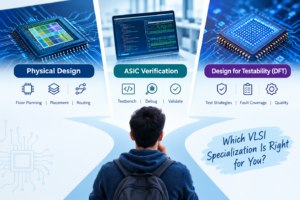
Starting with Physical Design and Design Verification to DFT, STA and Analog Design, each field is important in chip design. The meaning of the difference between physical design DFT DV VLSI is something that you should know before choosing your training program or when embarking on your career.
Understanding the Major VLSI Domains
1. Physical Design (PD)
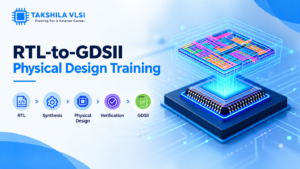
One of the most popular fields in the semiconductor industry is Physical Design. It deals with the transformation of the logical circuit design into a physical chip layout to be fabricated.
Key responsibilities include:
- Floorplanning
- Placement and routing
- Clock tree synthesis
- Power optimization
- Timing closure
This field is usually preferred by students who like backend design, optimization and working with EDA tools. Most freshers make comparisons between physical design vs design verification career as these two fields are highly demanded.
Physical Designers are also in high demand in semiconductor firms as the chips today are smaller and more complex.
2. Design Verification (DV)
Design Verification is a phase that verifies that a chip is working correctly prior to a manufacturing process. Test environments and simulations are developed by verification engineers to detect bugs in the design.
Main skills include:
- SystemVerilog
- UVM
- Functional verification
- Debugging
- Simulation methodologies
DV may be a great option when you like coding, solving problems and testing complex systems. Most students who study about the topic of which VLSI field to pursue as a career choice will tend to select DV due to its high demand in product companies.
The jobs of verification are common in India, particularly in Bengaluru and Hyderabad, where semiconductor giants are present.
3. Design for Test (DFT)
DFT is a professional field that aims at ensuring the testability of chips once they are manufactured. Modern chips have billions of transistors, therefore making testing critical to guarantee reliability.
Key concepts include:
- Scan insertion
- ATPG
- Boundary scan
- Fault coverage
- Compression techniques
DFT is usually explored by students seeking niche and high-valued skills. The queries involving the comparison of salaries between DFT and DV engineers in India have been on the rise since the two sectors have competitive remunerations.
DFT engineers are sought after since semiconductor firms are more interested in the quality of their products and efficient manufacturing.
4. Static Timing Analysis (STA)
STA is a timing-sensitive specialization that does not allow timing failures of signals within the chip.
Responsibilities include:
- Timing analysis
- Constraint validation
- Timing closure
- Signal integrity checks
STA professionals are in close collaboration with Physical Design engineers and therefore they need good analytical thinking. This is a subject that can be studied by students who like mathematics, circuit time and optimization problems.
STA is typically classified as part of Physical Design, but has increasingly become a very specialized skill area in the semiconductor industry.
5. Analog Design
One of the most demanding, yet rewarding, VLSI fields is analog Circuit Design. It is dedicated to the design of circuits such as amplifiers, PLLs, ADCs, DACs, and voltage regulators.
Important topics include:
- MOSFET modeling
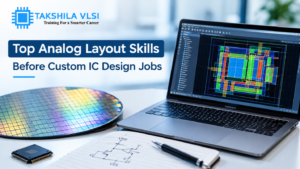
- Analog layout
- Mixed-signal design
- Low-power circuits
- Noise analysis
Analog Design is typically performed well by students who have good fundamentals in electronics and circuit theory. Analog Design is one of the few specializations of vLSI engineer that may demand more conceptual insight and accuracy.
The long-term prospects of the field are very good since seasoned analog engineers are always required in all parts of the world.
Industry Demand and Career Growth in India
Government programs and the growing enthusiasm of international chip companies have accelerated the growth of the semiconductor ecosystem in India. This development has generated high demand for good VLSI engineers in fields.
Bengaluru and Hyderabad cities still lead in the recruitment of:
- Physical Design Engineers
- ASIC Verification Engineers
- Analog Layout Engineers
- DFT Engineers
- Timing Engineers
Competition is on the rise; hence, industry-based practical training has become a necessity for freshers.
Why Practical Training Matters
The hands-on exposure that is expected of the candidates in VLSI companies includes:
- Industry-standard EDA tools
- Real-time projects
- Debugging workflows
- Timing analysis
- Verification methodologies
It is not usually sufficient to have theoretical knowledge. Practical laboratories, hands-on learning, role-playing interviews, and placement services are examples of institutions that make students industry-ready in a shorter time.
Conclusion
Semiconductors have various promising career opportunities, and knowing VLSI job roles explained in India 2026 is the initial step to creating a successful future. Physical Design, Design Verification, DFT, STA, or Analog Design—each of the specializations has a great opportunity to grow in India and other countries.
Students at Takshila VLSI undergo industry-based training that is aimed at bridging the gap between academics and real-world semiconductor work flows. Takshila equips students with skilled trainers, 24/7 lab access, project-based learning, mock interviews, and excellent placement assistance to enable them to enter the VLSI industry confidently. Their freshers and working professional job-oriented programs simplify the process of identifying which of the VLSI domains to pursue as a career and the skills that could be developed to succeed in the current competitive semiconductor market.