Today, the Semiconductor industry is expanding at a massive rate, which requires the workforce to have specialized skills in analog IC design. Many companies are on the lookout for Engineers with extensive skills for Chip Designing; thus, taking up a career in VLSI would be ideal. This Analog Layout Design Course would be a suitable training program if you are a fresher aspiring to gain expertise in Chip Design or already a working professional wishing to polish your existing skills.
Learn the kind of learning you can anticipate if it is the best type of program you seek, learn key talents you can achieve in and find out about employment.
What Is an Analog Layout Design Course?
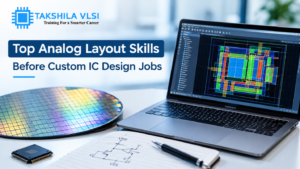
An analog layout design course covers the creation of the physical layout of analog and mixed-signal integrated circuits. Layout, which involves much more physical detail, sensitivity to matching devices, routing, symmetry, reducing interference, and the impact of the fabrication process compared to the design of purely digital circuits. The layout design course includes theoretical concepts as well as intensive lab hands-on experience on typical IC layout problems with industry CAD (EDA) tools.
What Will You Learn During the Course?
A typical analog layout training program covers the entire layout development flow, which consists of:
- An overview of analog/mixed-signal circuits
- Basic MOSFET properties and device matching
- Layout and floor planning
- Design rules and DRC theory
- LVS verification procedures
- Routing and interconnects optimization
- An introduction to parasitic extraction
- Layout optimization from performance perspective
- Working with industry standard EDA tools
- Mini-projects and practice.
Essential Analog Layout Skills for VLSI Engineers
Technical competencies expected in semiconductor companies involve more than simply theoretical concepts. The ideal training will cover analogue layout skills for VLSI engineers and the core areas of Analogue Layout design, to include:
- Device layout precision design
- Layout methods, placement-symmetrical layout design
- Symmetrical placement and matching
- Noise reduction & parasites removal
- Layout verification & debug methods
- Solving real chip layout problems
- Circuit design & Layout cross-team cooperation
Who Should Join This Course?
This analog layout course online is appropriate for:
- ECE graduates with an engineering background
- Freshers desiring to build their careers in VLSI
- Experienced working professionals seeking to build expertise in layout
- Engineers contemplating a career change to design from other domains like assembly
- Analog layout interview preparation.
Why Practical Training Matters
Analogue layout is more on a level with the skills & hands-on part, and quality analog IC layout training will encompass that, having good practical exposure, in-depth and robust lab sessions along with giving learners a hands-on opportunity to develop in-depth working on live projects in a given set of tools and mentoring to the trainees, so that they understand actual problems and can learn debug strategies.
Choosing the Right Custom Layout Design Course
When choosing a custom layout design course:
- Professional industry trainers
- Latest curriculum based on Semiconductor companies
- Hands-on tools experience
- Project-based learning
- Mock Interviews with Technical Assistance
- Job Assistance and Placement Support
- Choice between Online and Offline mode of learning
Career Opportunities After Analog Layout Training
When it comes to a career, once you complete an analog layout design course, there are a lot of job roles available in the industry for people with a background in analog design and layout. You can consider exploring various job profiles like the ones below:
- Analog Layout Engineer
- Custom Layout Engineer
- Mixed-Signal Layout Engineer
- Physical Design Engineer
- IC Design Engineer
- Layout Verification Engineer
Conclusion
To master analogue layout design, a blend of technical knowledge and skill together with industry experience is essential. At Takshila VLSI, our Analog Layout Training Courses prepare freshers and experienced professionals for actual jobs by providing industry professionals for guidance, sufficient lab practices with industry-driven and supported tools, real-time-based projects and consistent placement assistance with full career support. The programs are conducted under experienced trainers with round-the-clock tool availability and industry-driven practice. Through rigorous training on industry-relevant tools with periodic assessments, mock interviews and 24/7 career guidance, we help students to achieve expertise and a career in the VLSI and semiconductor industries.