Physical design is a problem of enormous scale. Billions of placement decisions, millions of nets, many timing corners and competing goals all have to be balanced at once. Engineers have long relied on experience and careful tool tuning to get through it. Now machine learning is joining the toolbox.
This guide explains how AI in physical design actually works, where it helps in floorplanning, placement, routing and timing, and how engineers should think about it. If you are new to the flow, our RTL-to-GDSII roadmap is a good companion read.
Why Physical Design Is a Good Target for AI
- Vast design space. Each flow has hundreds of knobs, such as effort levels, constraints and strategies, and good settings differ from design to design.
- Measurable results. Power, performance, area, congestion and slack are numbers, so success is easy to score.
- Repeated runs. Teams run similar flows again and again, which creates data to learn from.
- Expensive iteration. A full run can take many hours, so reducing the number of trials is valuable.
Two Ideas Behind AI-Driven EDA
Design-space exploration
Instead of an engineer trying settings one by one, an optimisation engine launches many runs, learns which choices improve the result and steers toward better ones. Reinforcement learning and related methods are commonly used here. This approach powers commercial tools from the major EDA vendors.
Learning from past designs
Some tools reuse knowledge from earlier projects, so a new design starts from a better position than a blank slate. For example, a model trained on previous floorplans can suggest a starting arrangement for macros on a similar chip.
AI Across the Physical Design Stages
| Stage | How AI and ML help | Engineer still decides |
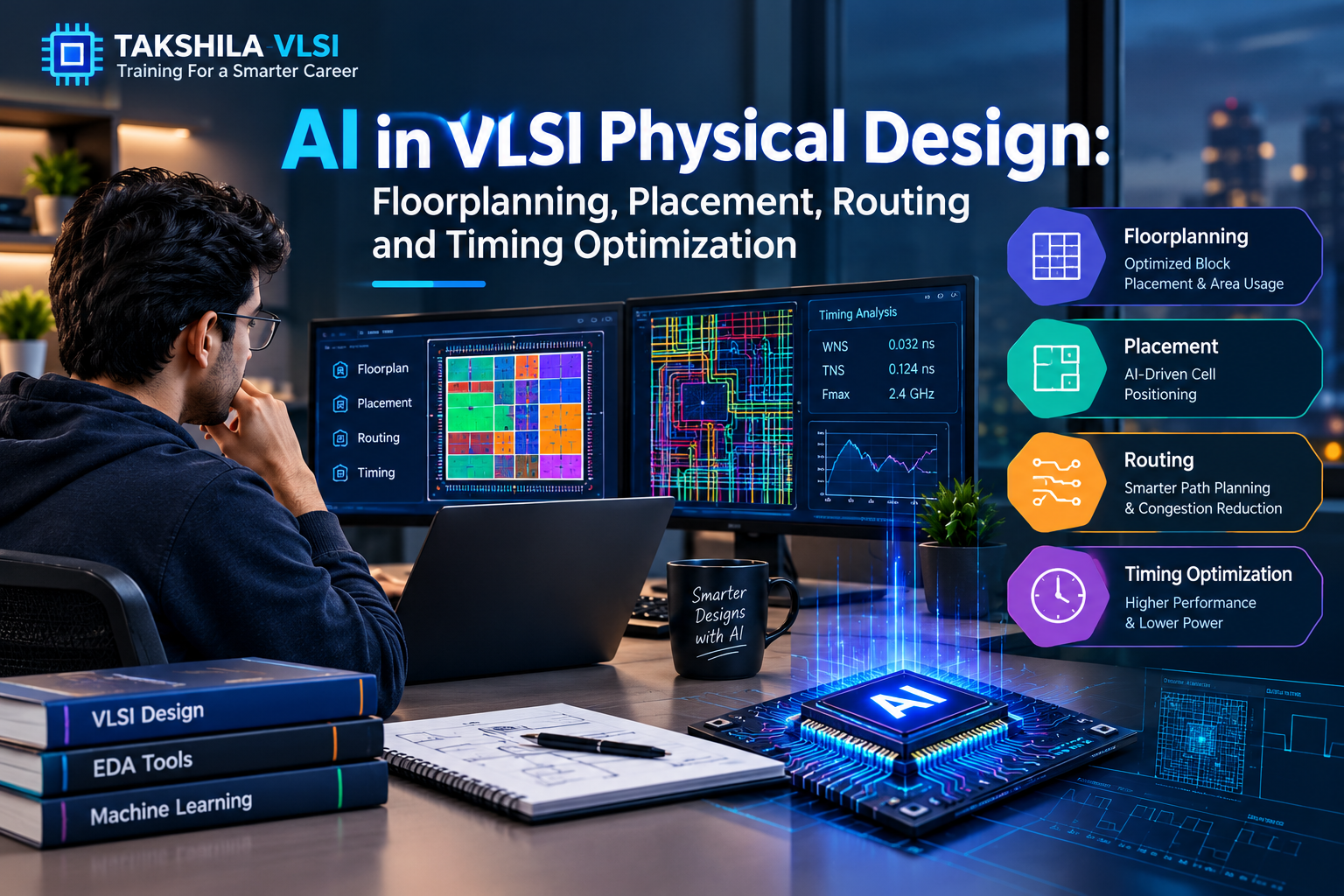
| Floorplanning | Suggests macro placement and aspect ratios; explores alternatives | Which floorplan meets power, routing and project constraints |
| Placement | Predicts congestion and timing hotspots early; tunes placement settings | Whether utilisation and region constraints are sensible |
| Clock tree synthesis | Explores buffering and tree strategies | Skew and latency targets, and clock architecture |
| Routing | Predicts routability and design rule violations; guides fixes | Handling of special nets and signoff-critical routes |
| Timing and power optimisation | Chooses sizing, buffering and threshold-voltage trade-offs | Signoff margins and acceptable risk |
| Signoff and ECO | Prioritises violations and suggests fixes | Final approval for tape-out |
Floorplanning
Macro placement is a classic hard problem. Moving a single large memory can change congestion and timing across the whole block. Research and commercial tools use learning-based approaches to propose macro positions that reduce wire length and congestion. Engineers evaluate the suggestions against power grid, routing channels and clock needs.
Placement and Congestion Prediction
Predicting where routing congestion will occur before routing starts saves time. Models trained on earlier runs can flag risky regions during placement, so the tool or the engineer can adjust before expensive routing runs begin.
Routing and DRC Fixing
Detailed routing leaves violations to be fixed. Learning methods help predict which areas will cause trouble and can guide repair strategies. Detailed routing engines themselves remain classical algorithms; AI usually advises or steers them rather than replacing them.
PPA Optimisation and Timing Closure
Power, performance and area pull against each other. AI-driven optimisation tools explore many combinations of settings to find better trade-offs than manual tuning often reaches. Vendors and customers have reported improvements in PPA and large reductions in engineering effort on some designs. For example, Cadence management cited customer-reported PPA gains in the range of roughly 7 to 12 percent in physical design. These figures come from specific designs and vendor reporting, so your own results will vary.
Agentic Workflows in Implementation
Newer tools go beyond tuning one step. Siemens introduced an AI agent that assists with place-and-route, timing closure and power optimisation through its Aprisa software, and Synopsys has announced agent-based implementation solutions as part of its AgentEngineer portfolio, with general availability planned for the end of 2026. These aim to run longer parts of the flow with less manual intervention.
Benefits
- Faster exploration of options than manual tuning
- Better use of past project knowledge
- Earlier warnings about congestion and timing problems
- Less time spent on repetitive tasks, leaving more for architecture and judgement
- Potential improvements in PPA on complex blocks
Limitations
- Dependence on data. A model trained on one kind of design may behave poorly on a very different one.
- Limited explanation. It can be hard to know why a particular choice was made, which complicates debugging.
- Compute cost. Exploring many runs in parallel uses large amounts of compute.
- No substitute for signoff. Final timing, power and physical verification still rely on trusted, established tools.
- Claims vary. Results published by vendors reflect selected cases.
The Role of Established EDA Tools
AI does not replace the place-and-route engine, the static timing analyzer or the physical verification tool. Those remain the sources of truth. AI sits on top, choosing settings, predicting problems and orchestrating runs. That is why a physical design engineer’s core understanding of STA, floorplanning, CTS and routing matters more, not less: you need it to judge whether the AI’s decisions make sense.
Skills to Build
- Solid physical design fundamentals, especially STA, congestion analysis and power planning
- Scripting in Tcl and Python to automate runs and collect results
- Data analysis habits: comparing runs, spotting trends and tracking metrics across experiments
- Experiment design: changing one thing at a time and recording outcomes
- Basic ML literacy: understanding what training data, overfitting and generalisation mean
A Practice Exercise
- Take a small open-source design and run it through a complete flow, for example using the OpenROAD flow.
- Vary three settings, such as utilisation, placement density and clock period, and record area, power, congestion and slack for each run.
- Plot the results and describe the trade-offs.
- Write a simple script that runs the sweep automatically and tabulates the results.
- Reflect: how would a learning-based tool improve on your manual sweep?
This exercise teaches the same thinking that AI-driven tools automate, and it makes a strong portfolio item.
Interview Questions You May Face
- How can machine learning help predict routing congestion?
- What are the risks of relying on an AI-tuned flow for tape-out?
- How would you compare two runs fairly, and what metrics would you use?
- Why does an AI-optimised result still require full signoff checks?
Conclusion
AI is becoming a practical part of physical design, mainly as an optimiser, a predictor and an assistant that automates repetitive flow steps. The craft still rests on understanding timing, power and layout. Learn the fundamentals first, then use AI to extend your reach.
To learn those fundamentals with guided practice, explore the physical design courses and STA tutorials at Takshila Institute of VLSI Technologies.