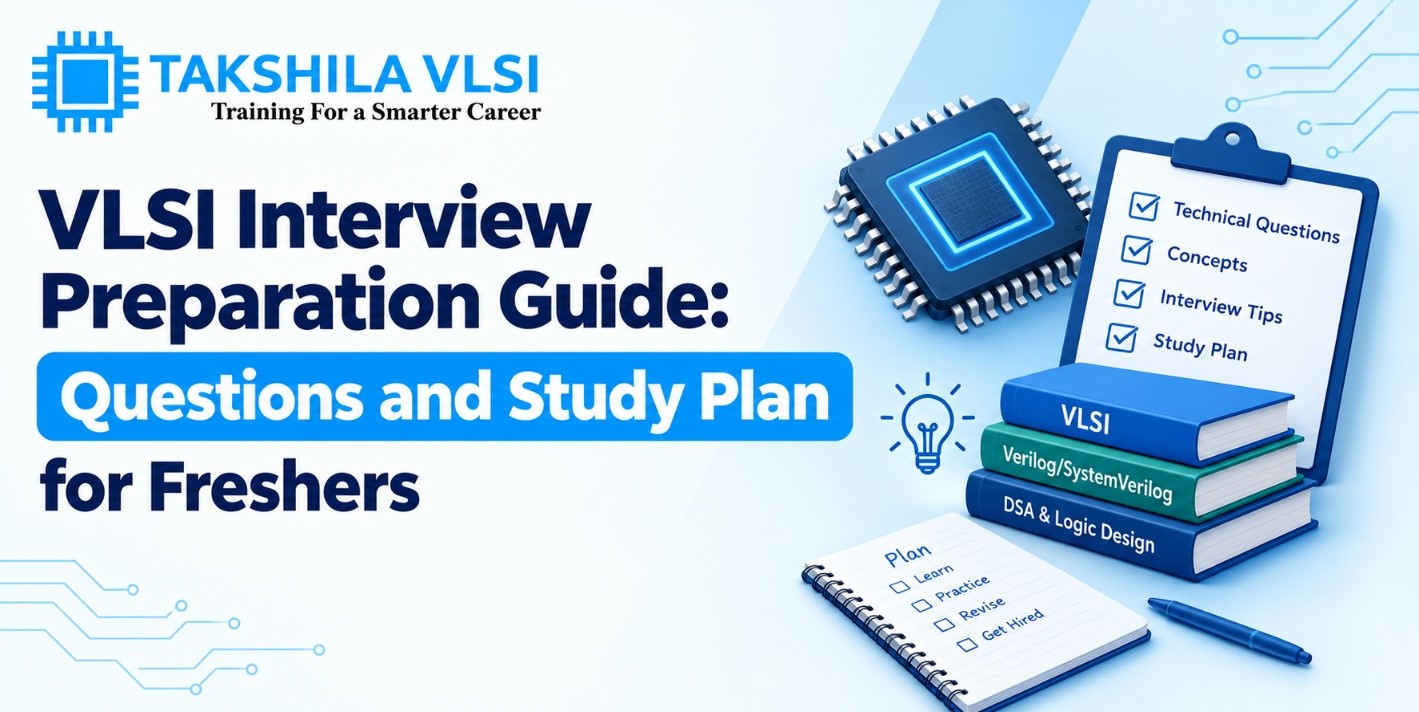
A VLSI interview is rarely a quiz on definitions. Interviewers want to see how you think. They will start with a simple question, follow your answer with “why?”, and keep going until they reach the edge of your understanding. That edge is exactly what they are measuring.
This guide organises VLSI interview preparation by topic and specialization, so you can focus on what your target role actually asks. It includes sample VLSI interview questions for freshers, a study plan and a mock interview routine.
How VLSI Interviews Are Usually Structured
- Screening round: a short call covering basics such as digital electronics and your resume.
- Technical rounds: deep questions in your specialization, often with problems solved on paper or a whiteboard.
- Project discussion: questions about your own work, where depth matters more than polish.
- HR round: motivation, communication and fit.
The first two stages share a common core, so start there.
Core Topic 1: Digital Electronics
Nearly every interview, whatever the specialization, begins here. Be ready for:
- Setup time, hold time and what happens when either is violated
- Metastability and how synchronizers reduce its risk
- Differences between latches and flip-flops
- Designing a sequence detector with an FSM
- Minimising logic with Boolean algebra and K-maps
- Frequency dividers, including divide-by-odd-numbers with 50 percent duty cycle
- FIFO depth calculation for different read and write rates
Core Topic 2: Verilog and RTL Coding
- Blocking versus non-blocking assignments, with an example of each
- How an unintended latch gets inferred
- Difference between wire and reg, and between always and assign
- Synchronous versus asynchronous reset
- Writing a synchronous FIFO, a clock divider or an edge detector on paper
- Difference between a task and a function
Interviewers often ask you to write short code live. Practise by hand, without a simulator, until your syntax is reliable.
Core Topic 3: SystemVerilog and UVM (Verification Roles)
- Difference between a class and a module, and a handle and an object
- What is polymorphism, and why does UVM depend on it?
- Mailbox, semaphore and event: when would you use each?
- Constraints, randomization and how to debug a randomization failure
- Functional coverage versus code coverage
- UVM phases, factory and the configuration database
- Sequence, sequencer and driver handshake
- How would you verify a FIFO? Walk through your plan.
Core Topic 4: Static Timing Analysis
STA matters for physical design and DFT roles, and is useful knowledge for RTL engineers as well.
- How setup and hold slack are calculated
- What causes a hold violation and ways to fix it
- What is clock skew, and can it ever be helpful?
- Meaning of multiple corners, on-chip variation and derating
- False paths and multicycle paths: when do you declare them?
- Clock gating checks and recovery and removal checks
Core Topic 5: Physical Design
- Steps from netlist to GDSII, in order
- What goes into a good floorplan?
- How do you handle congestion?
- Clock tree synthesis goals and the meaning of skew and insertion delay
- Difference between global and detailed routing
- IR drop and electromigration, and how power planning addresses them
- Antenna violations and their fixes
- Crosstalk and its impact on timing
Core Topic 6: Design for Testability
- Why DFT is needed, and what scan insertion does
- Working of a scan flip-flop in shift and capture modes
- Stuck-at versus transition fault models
- What fault coverage means and how to improve it
- Purpose of a lockup latch
- Memory BIST and boundary scan basics
Specialization-Wise Focus
| Target role | Highest priority topics | Supporting topics |
| RTL design | Verilog, FSM, digital logic, CDC | Synthesis, STA basics |
| Verification | SystemVerilog, UVM, coverage, debug | Digital design, protocols |
| Physical design | STA, floorplan, CTS, routing | Scripting, power analysis |
| DFT | Scan, ATPG, fault models | STA, Verilog, BIST |
| Analog layout | Matching, parasitics, DRC and LVS | CMOS and analog basics |
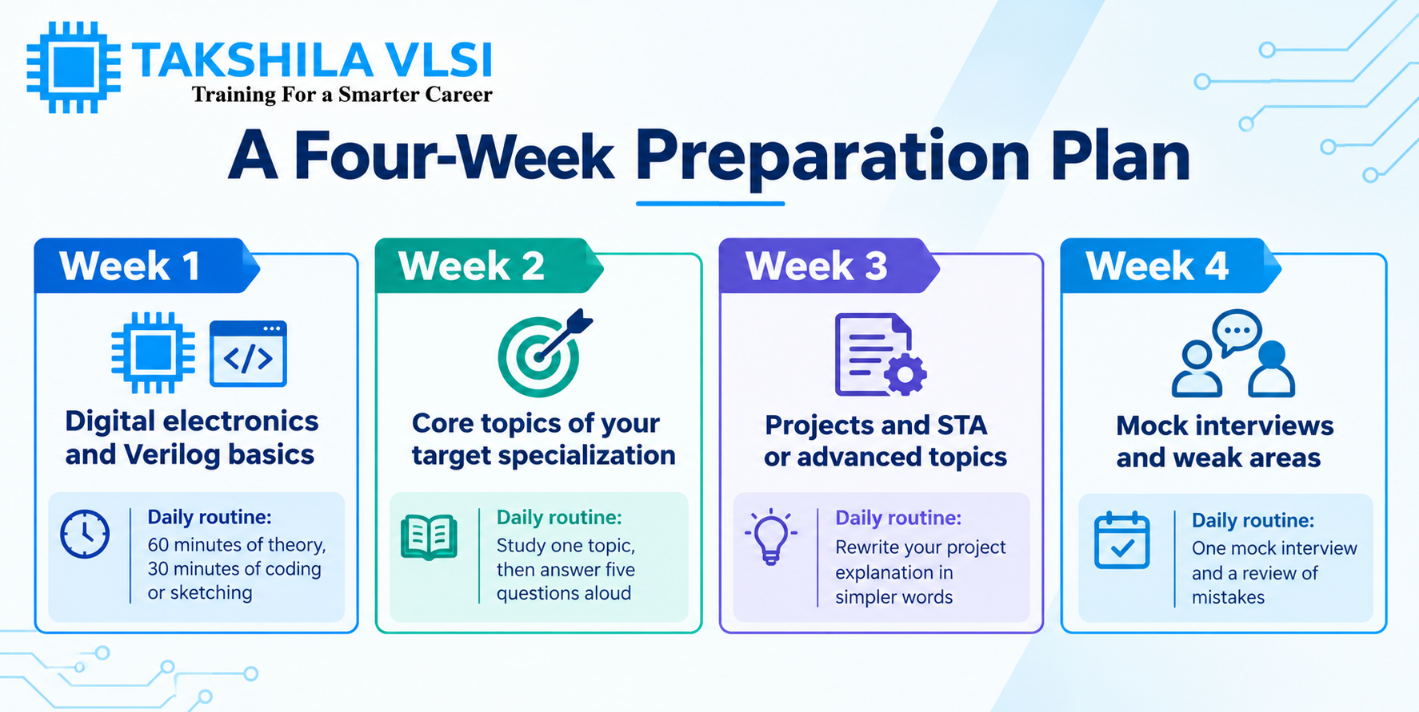
A Four-Week Preparation Plan
| Week | Focus | Daily routine |
| 1 | Digital electronics and Verilog basics | 60 minutes of theory, 30 minutes of coding or sketching |
| 2 | Core topics of your target specialization | Study one topic, then answer five questions aloud |
| 3 | Projects and STA or advanced topics | Rewrite your project explanation in simpler words |
| 4 | Mock interviews and weak areas | One mock interview and a review of mistakes |
Prepare Your Projects Like Exam Topics
Interviewers will ask about anything on your resume, so every line must be defensible. For each project, be ready to answer:
- What problem were you solving, and why?
- What was your specific contribution?
- What tools did you use?
- What was the hardest bug or violation, and how did you fix it?
- What would you change if you did it again?
Mock Interview Exercises
- Explain aloud: pick a topic such as setup and hold and explain it in two minutes to a friend who is not an engineer.
- Whiteboard practice: solve a design problem with only paper and a pen.
- Rapid-fire round: ask a partner to fire twenty short questions and answer each in one or two sentences.
- Project grilling: have someone ask “why?” five times after each answer about your project.
- Record yourself. Watching the recording reveals filler words and unclear explanations.
Tips for the Day Itself
- If you do not know an answer, say so, then explain how you would reason about it.
- Think aloud on problem-solving questions. The process matters as much as the answer.
- Ask a clarifying question before solving. It shows maturity.
- Keep answers structured: definition, example, then implications.
- Be honest about your level. Overclaiming usually gets exposed in the next follow-up question.
Keep Practising
Interview skill is built through repetition. Study the core topics, practise explaining them aloud, understand your own projects completely and take mock interviews seriously. Over a few weeks the difference in confidence is noticeable.
For technical tutorials, project guidance and structured training, visit Takshila Institute of VLSI Technologies and explore the programs that match your target role.