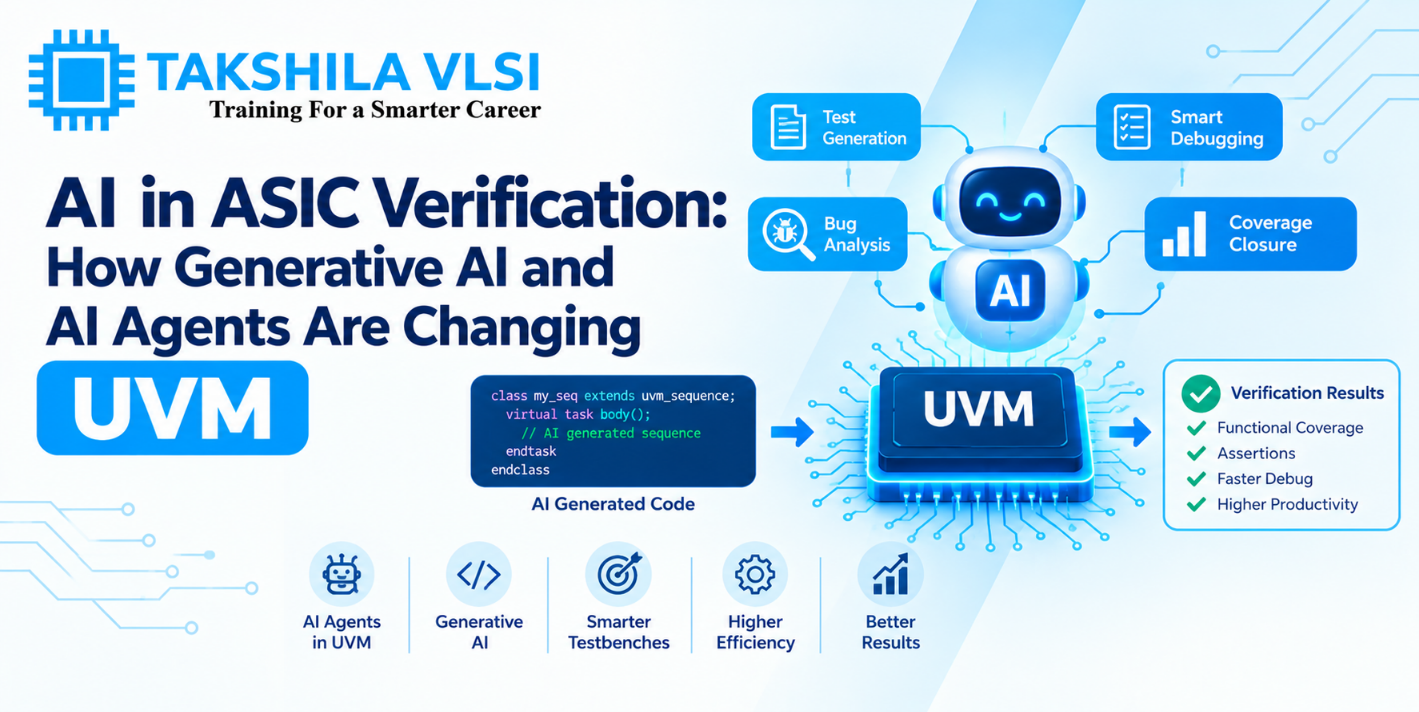
Verification is where chip projects spend a huge share of their effort. The reason is simple: finding a bug in simulation costs a few hours, while finding it in silicon can cost months and millions. So any technology that helps verification teams find bugs faster gets serious attention, and AI has become the most discussed candidate.
This article explains how AI in ASIC verification is being used today, where it helps most, where it falls short, and what a verification engineer should learn to work effectively alongside it.
Why Verification Is Ready for AI
- Boilerplate is everywhere. UVM environments contain a great deal of repetitive structure.
- Failures generate heavy analysis work. A nightly regression can produce hundreds of failing tests, and many share the same root cause.
- Specifications are long. Turning pages of text into a test plan is time-consuming.
- Coverage closure is slow. Reaching the last few percent often takes weeks of effort.
These are exactly the tasks where pattern recognition and text generation can save time.
Where AI Helps in the Verification Flow
1. Verification Planning
An AI assistant can read a specification and propose a list of features, scenarios and corner cases to verify. This gives the team a starting draft of the verification plan. Engineers still decide what matters, since a model may miss unusual requirements or add irrelevant ones.
2. Testbench and UVM Component Generation
Generative models can draft the skeleton of a UVM environment: sequence items, drivers, monitors, agents, scoreboards and configuration objects. Given an interface description, they can write much of the repetitive code. This is especially useful for learners who understand the architecture but are slowed down by syntax and macros.
3. Sequence Creation
AI can suggest directed and constrained-random sequences for a protocol, such as back-to-back transfers, boundary addresses or error injection. Treat these as ideas to evaluate, because a sequence that looks thorough may still leave important states untouched.
4. Assertion Generation
Turning a sentence in a specification into a SystemVerilog assertion is a natural job for a language model. For example, the requirement “every request must receive a grant within four cycles” can become:
assert property (@(posedge clk) disable iff (!rst_n)
req |-> ##[1:4] gnt);
The model might get this right, but it could also misread edge cases, such as whether the request must remain asserted until the grant arrives. Review each generated assertion against the specification, and confirm it can both pass and fail by testing it.
5. Coverage Analysis
Coverage reports contain many holes. AI can group them, suggest which scenarios would close them and point out holes that look unreachable. The final decision on whether a hole is a real gap or an acceptable exclusion belongs to the engineer.
6. Failure Triage
After a regression, many failures often stem from a handful of causes. AI can cluster failures by log message, stack pattern or time of failure, so that engineers debug one representative case rather than fifty identical ones. This is one of the most practical benefits today.
7. Waveform and Log Debugging
Agent-style tools can read logs, inspect signals, propose a hypothesis and test it by rerunning a simulation. Engineers should treat the result as a lead to be confirmed, not a verdict.
The Rise of Verification Agents
Beyond single-step assistants, EDA vendors have introduced agent systems that plan a goal, call simulators and other tools, read the results and loop until they reach an outcome. In 2026, Cadence, Synopsys and Siemens each announced agentic offerings for design and verification, including a toolkit from Siemens with separate agents for RTL coding, linting, clock-domain crossing, verification planning and debug. The vendors report sizeable productivity gains in their own examples, and availability ranges from early access to planned general release, so check current status before depending on any claim.
The important detail is how these agents work. They do not replace the simulator. They use the simulator as the source of truth, which is what keeps their output grounded.
Why Simulation, Formal Checks and Human Review Still Matter
| Safeguard | Why AI cannot replace it |
| Simulation | It provides ground truth. A generated test that never runs proves nothing. |
| Formal verification | It can prove properties for all inputs, which no sampled test can. |
| Coverage | It measures what was actually exercised, not what the model claims to have tested. |
| Engineer review | It catches misread specifications, missing scenarios and false confidence. |
| Sign-off process | Accountability sits with people and procedures, not with a tool. |
A subtle risk is circularity. If the same AI writes the design, the testbench and the assertions from the same misunderstood specification, they may agree with each other and all be wrong. Independent checking and a human who understands the original intent break that loop.
A Sensible AI-Assisted Verification Workflow
- Write or refine the specification clearly. Ambiguity leads to ambiguous tests.
- Use AI to draft a verification plan, then edit it with design and architecture input.
- Generate environment skeletons and sequences, and review every file.
- Run in simulation with assertions and coverage enabled.
- Use AI to cluster failures and suggest causes, then confirm each by hand.
- Close coverage with a mix of AI suggestions and engineer-written tests.
- Add formal checks where they are most effective, such as control logic and protocols.
- Record what the AI got wrong. These notes become your review checklist.
Skills Verification Engineers Should Build
- Deep SystemVerilog and UVM knowledge. You cannot review generated code you do not understand.
- Protocol and design understanding. Knowing what correct behaviour looks like is the core skill.
- Assertion and formal basics. These are the best independent safeguards.
- Debugging discipline. Form a hypothesis, test it, and avoid random changes.
- Python helps you process logs, run regressions and connect tools.
- Prompting with context. Give the model the interface, protocol rules and coding style.
Interview Angle
Expect questions about how you would validate something that was generated, not just how to write it. Be ready to answer:
- How would you check an AI-generated testbench for gaps?
- Why is passing simulation not enough to claim verification is complete?
- How do assertions differ from scoreboard checks, and why use both?
- How would you handle a model that wrote an assertion you believe is wrong?
Practise With a Mini Project
Take a small design such as a FIFO or APB slave. Build a UVM environment by hand first. Then ask an AI assistant to produce the same environment, and compare the two: what did it forget, what did it invent, and what did it do better? Insert a few bugs into the design and see which environment catches them. The comparison teaches more than either approach alone.
Summary
AI is genuinely changing the daily work of verification, particularly in drafting code, triaging failures and exploring coverage. It does not change what verification is for: building evidence that a design works. Engineers who combine strong UVM skills with careful AI use will be in the strongest position.
To build that foundation, explore the ASIC verification courses, SystemVerilog tutorials and verification project guides at Takshila Institute of VLSI Technologies.