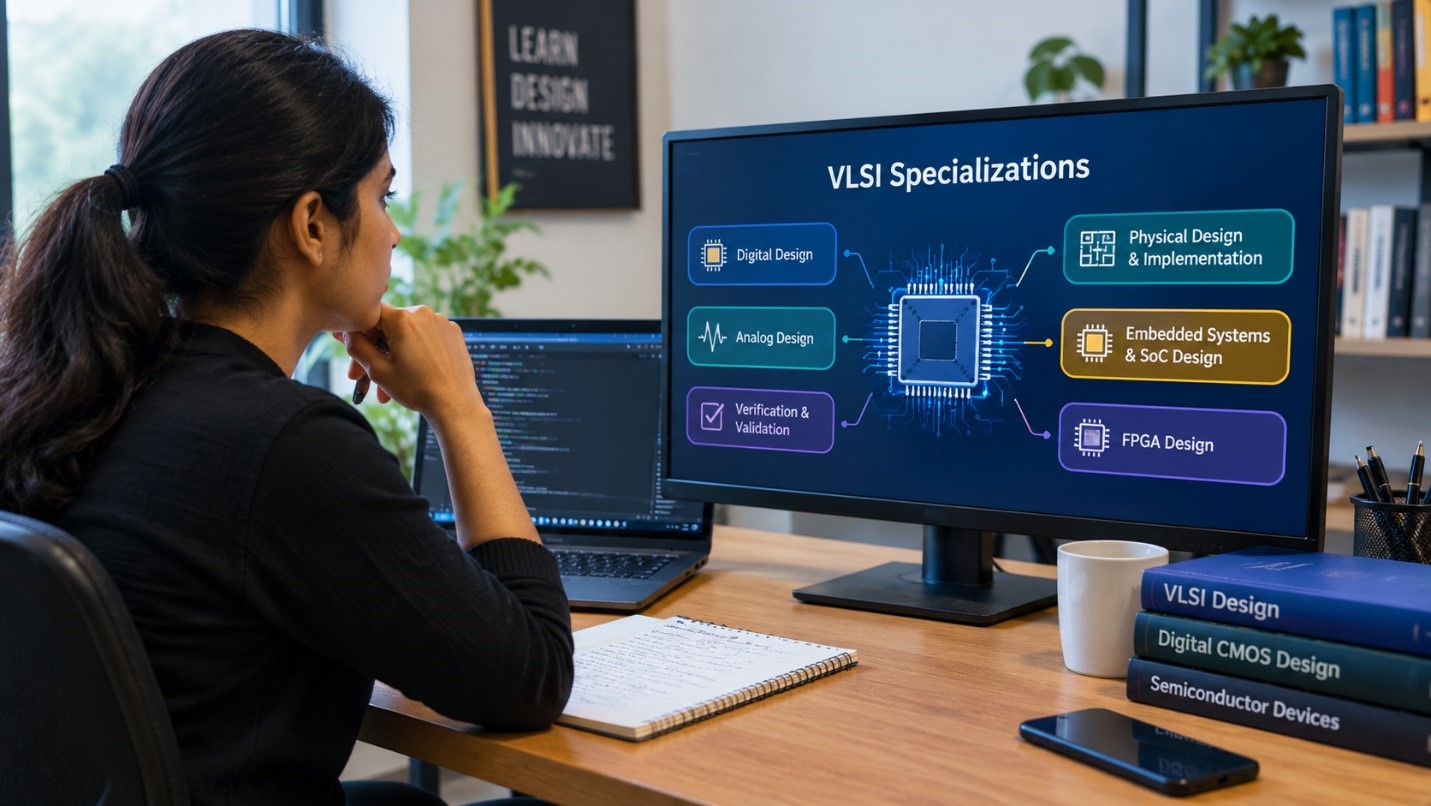
Most people who enter the chip industry don’t pick a specialization so much as stumble into one. A campus recruiter needs verification engineers, so you become one. A friend lands a physical design role, so you follow. Sometimes that works out. Often it leaves people five years in, wondering whether they’d have been happier doing something else.
Choosing your VLSI specialization on purpose is one of the highest-value decisions you’ll make early in your career. This guide breaks down the main VLSI career options, who tends to enjoy each, and how to decide without guessing.
Is there a “best VLSI specialization”?
Not in the way most search results imply. Salaries, demand and growth vary by company and year, but every major track has strong long-term prospects. The better question is which one suits you, because you’ll spend thousands of hours on it. Someone who likes debugging puzzles will thrive in verification. Someone who likes seeing a physical result will lean toward layout. Fit beats trend.
The main VLSI career specializations
Think of this as a map of the VLSI career path, with several branches that all lead into VLSI design careers of different kinds.
RTL design (front-end)
Front-end designers describe hardware in Verilog or SystemVerilog and shape how a block works: the state machines, datapaths and interfaces.
Good fit if you: enjoy logic, like architecture-level thinking, and are comfortable with abstraction.
Watch out for: fewer openings than verification at entry level, and a strong expectation of solid fundamentals.
Design verification
Verification engineers try to break the design before the silicon does. They write testbenches, build UVM environments, define coverage goals and hunt for corner cases.
Good fit if you: are curious, a little stubborn, and enjoy debugging. It’s also the most common doorway for freshers.
Watch out for: it’s software-heavy, so you’ll write a lot of code, and the work can feel repetitive during regressions.
Physical design
This is where the netlist becomes a layout. You deal with floorplanning, placement, clock tree synthesis, routing, congestion and timing closure.
Good fit if you: like methodical, detail-oriented work and don’t mind scripting.
Watch out for: the early learning curve is steep, and deadlines cluster around tape-out.
Design for test (DFT)
DFT engineers add scan chains, built-in self-test and other structures so manufacturers can catch defects. It’s a niche with steady demand and fewer people trained for it.
Good fit if you: like the overlap between design and manufacturing, and enjoy structured problem solving.
Watch out for: less visible than design or verification, so you may need to explain its value in interviews.
Analog and mixed-signal design
Amplifiers, data converters, PLLs, power management. The work is continuous rather than digital, and intuition matters as much as formulas.
Good fit if you: love circuit theory and don’t mind slow, deep learning.
Watch out for: fewer entry-level positions, and many employers prefer a master’s degree.
Post-silicon validation
When real chips come back from the fab, validation engineers bring them up, test them and find issues that simulation missed. It combines hardware, firmware and lab work.
Good fit if you: like hands-on debugging with actual boards and instruments.
Watch out for: requires comfort with both hardware and low-level software.
A simple way to decide
Skip the comparison charts for a moment and ask yourself four questions.
What kind of problems do you enjoy? If you like proving things wrong, think verification. If you like building from nothing, think design. If you enjoy optimization puzzles, look at physical design.
How do you feel about coding? Verification and physical design involve a lot of scripting and programming. Analog involves far less.
How long are you willing to specialize before earning well? Analog and some physical design paths take longer to mature. Verification can get you working sooner.
Where do you want to be in ten years? Some people aim for architecture, some for technical leadership, some for a startup. Front-end design and verification experience often lead toward architecture. Physical design leads toward implementation leadership.
Test before you commit
Reading descriptions only goes so far. A better approach is to try each area for a few weeks:
- Write a small Verilog module and simulate it. Did you enjoy seeing it work?
- Build a basic testbench that tries to break it. Did hunting for bugs feel fun or draining?
- Run a simple synthesis and timing report. Did the numbers interest you?
Your reaction to these small experiments tells you more than any career blog, including this one. Many VLSI courses for engineers include a foundation phase so you can explore before choosing, and that’s worth looking for.
What to look for in specialization courses
Not all programs are equal. When comparing VLSI career specialization training, check for:
- Tool-based labs. You should work with industry-standard flows, not only watch demos.
- Project work. At least one end-to-end project per track gives you something to discuss in interviews.
- Trainers with industry experience. People who’ve shipped chips explain trade-offs textbooks skip.
- A clear syllabus. Vague promises like “complete VLSI mastery” are a warning sign.
- Interview and portfolio support. Mock interviews and resume reviews help freshers more than they expect.
Can you switch later?
Yes, and plenty of people do. Verification engineers move into design. Physical design engineers move into methodology. The first few years teach transferable habits, like reading specs carefully and thinking about timing, regardless of track. Just don’t treat your first choice as permanent or as a trap.
Final thoughts
The right VLSI specialization is the one that matches how you think and what energises you on a regular Tuesday, not only during a good project week. Explore a couple of areas, build one small project in your top choice, and then commit with confidence.
When you’re ready to go deeper into one track, look at the specialization programs at Takshila VLSI and choose the path that fits your goals.
Frequently asked questions
Which VLSI specialization is easiest for freshers?
Verification usually has the most entry-level openings, though “easiest” depends on your strengths.
Which specialization pays the most?
Pay varies by company and experience. Physical design, DFT and analog all pay well at senior levels, so don’t choose on salary alone.
Do I need a master’s degree for any track?
Analog and some research-oriented roles often prefer it. Most digital design and verification roles hire strong bachelor’s graduates.