Every year, thousands of electronics and communication engineering graduates set their sights on a career in VLSI, and physical design remains one of the most sought-after entry points. It pays well, it is intellectually demanding, and it sits right at the heart of how a chip actually gets built. But here is the catch: not every “physical design course” advertised online is built the same way, and a fresher rarely has the experience to tell a strong program apart from a rushed one. Before you swipe your card and enrol, there are a handful of things worth checking carefully.
Does the Course Actually Start From the Basics?
A genuine fresher-friendly program does not assume you already know the semiconductor flow inside out. It should begin with the fundamentals CMOS basics, standard cell libraries, timing concepts, and an overview of the RTL-to-GDSII flow before moving into tool-specific training. If a course jumps straight into floorplanning commands without first explaining why floorplanning matters, you will end up memorising steps instead of understanding the logic behind them. That difference shows up very quickly in interviews, where recruiters are far more interested in your reasoning than your ability to recall a menu option.
Is the Curriculum Aligned With the Real RTL-to-GDSII Flow?
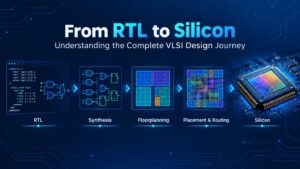
Physical design is not a single skill; it is a sequence of stages floorplanning, power planning, placement, clock tree synthesis, routing, and physical verification each with its own goals and trade-offs. A course worth its fee should walk you through every one of these stages in order, on a real design, rather than covering them as isolated theory chapters. Ask to see the course outline in detail. If timing analysis or physical verification is squeezed into a single session near the end, that is a sign the program is more interested in covering topics than teaching them properly.
What Tools Will You Actually Get Hands-On Time With?
This is where many freshers get misled. Some institutes only demonstrate tools during a live session while students watch; others give limited, shared access for a few hours. What you want instead is enough individual hands-on time on industry-standard EDA tools to run a design from start to finish on your own, make mistakes, debug them, and fix them yourself. Ask specifically how many hours of independent lab access are included and whether you get to work on more than one design during the course. A course that only shows you a tool is not the same as a course that teaches you to use it.
Does It Include a Real Project, Not Just Exercises?
Small exercises are useful for practising individual commands, but they rarely prepare you for the kind of open-ended problem solving that a real job demands. Before enrolling, check whether the course includes at least one complete project where you take a design through the entire physical design flow, encounter realistic issues like congestion or timing violations, and learn to resolve them. A project like this becomes something you can speak about confidently in an interview and even walk a panel through, step by step.
Who Is Actually Teaching You?
The value of a physical design course depends heavily on the person delivering it. Ask about the trainer’s industry background how many years they have spent working on actual tape-outs, which companies they have worked with, and whether they are still connected to the industry or have been training exclusively for years without recent hands-on exposure. A trainer who has faced real deadlines and real chip failures brings a kind of practical judgment that no textbook can replace, and that judgment is often what separates a good explanation from a great one.
Is There Support for Doubts After Class Hours?
Learning physical design is rarely a linear process. You will hit a wall at some point a script that will not run, a timing report that makes no sense, a placement that keeps failing DRC. What matters is whether you have somewhere to turn when that happens. Look for programs that offer mentor support outside scheduled class time, whether through doubt-clearing sessions, a dedicated support channel, or one-on-one help. A course that disappears the moment the session ends leaves you to struggle alone exactly when you need guidance the most.
Does the Course Prepare You for Interviews, Not Just Exams?
Finally, check whether the program includes some form of interview preparation mock interviews, curated question banks, or resume guidance tailored to physical design roles. Technical competence gets you in the door, but being able to explain your project, defend your design choices, and answer conceptual questions under pressure is what actually gets you the offer. A course that ends with a certificate but no interview readiness leaves half the job undone.
Watch Out for Batch Size and Personal Attention
One detail freshers often overlook is how many students are in a single batch. A course capped at a reasonable batch size allows the trainer to actually notice when someone is struggling and step in, whereas an overcrowded batch tends to move at the pace of the fastest learners while everyone else quietly falls behind. Before enrolling, ask about the typical batch size and whether the training format allows for individual attention, especially during the hands-on lab sessions where most of the real learning happens.
Check Placement Assistance, Not Just Placement Promises
Almost every institute claims to offer “placement assistance,” but the meaning of that phrase varies enormously. For some, it means sharing a few job postings in a WhatsApp group; for others, it includes structured resume reviews, mock interviews, and direct connections with hiring companies. Ask for specifics how many of last year’s freshers were placed, what kind of companies they moved into, and what concrete support you can expect once your course ends. A vague answer here is often more revealing than the marketing brochure.
Making the Right Choice
Choosing your first physical design course is not just about ticking a box on your resume it shapes how confidently you walk into your first interview and how quickly you become productive on your first job. At Takshila Institute of VLSI Technologies, our physical design programs are built around the complete RTL-to-GDSII flow, generous individual hands-on lab time, real project work, and mentors with genuine industry experience. Before you decide where to enrol, take a look at our course calendar and see how a structured, industry-aligned program can set the right foundation for your VLSI career.