Search for online VLSI training and you’ll find dozens of options, all promising job-ready skills in a few months. Some are excellent. Some are recorded lectures with a certificate attached. From the outside, they can look nearly identical.
Chip design is a hands-on discipline, so the gap between a good and a poor program shows up later, usually in your first technical interview. Here’s how to tell them apart before you pay.
Why online VLSI training is a different problem
Software courses translate to video easily. You watch, you code, you run it on your laptop. VLSI is harder, for a few reasons:
- The industry tools are expensive and licensed, so you can’t just download them.
- Many tools run only on Linux servers.
- Learning depends on debugging, and debugging needs someone to ask when you’re stuck.
A good online VLSI course solves each of these problems. A weak one ignores them. If you’re searching for an online chip design course, the same test applies. So the question to ask isn’t “is it online?” but “how does it handle the parts that normally need a lab?”
What a quality program should include
1. Live instruction, not just recordings
Recorded lessons are fine as a supplement. They shouldn’t be the core. Live online VLSI classes (often called live VLSI training) let you interrupt, ask why a simulation behaves oddly, and watch an instructor debug in real time. Seeing an expert get stuck and work through it teaches more than a polished demo ever will.
Check whether sessions are recorded for revision, and whether you can ask questions during class and afterwards.
2. Real tool access through virtual labs
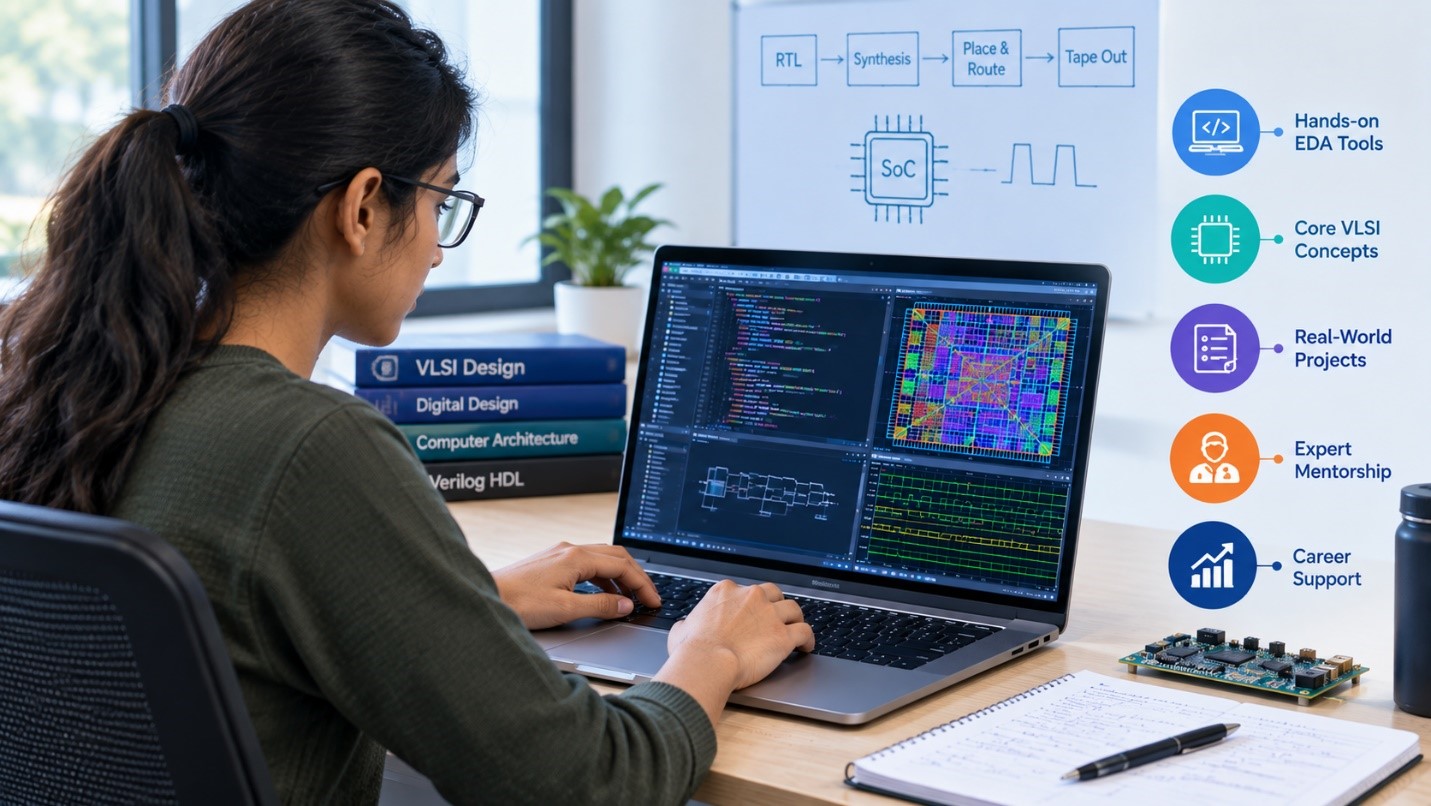
This is the biggest differentiator. Ask directly: will I run commercial-grade EDA tools, and where? Good programs provide remote lab access, effectively virtual VLSI labs, to servers with simulators, synthesis tools and physical design flows, so you work in an environment that looks like a real company’s.
If the answer is “we’ll show you screenshots,” keep looking.
3. A structured, transparent syllabus
You should be able to read exactly what you’ll learn, in what order. A solid curriculum usually covers:
- Digital design and CMOS fundamentals
- Verilog and SystemVerilog
- Verification methodology, including UVM for verification tracks
- Static timing analysis and synthesis concepts
- Physical design flow, or DFT, depending on the track
- Scripting in Python, Tcl and shell
Be cautious about vague outlines or syllabi that promise every specialization in a few weeks. Depth takes time.
4. Projects you can show employers
Lectures alone don’t make you employable. A good program ends with substantial project work: a block-level design with a verified testbench, a timing-closed implementation, or a protocol verification environment. These become your portfolio and your interview talking points.
Ask to see sample projects from previous batches. Reputable providers are happy to share them.
5. Trainers who’ve worked in the industry
Ask who teaches and what they’ve done. An instructor who has been through tape-out can explain why a constraint matters, not only what it is. Look for people with real experience at semiconductor or EDA companies.
6. Feedback and mentoring
Online learning fails when people feel invisible. Look for assignment reviews, doubt-clearing sessions, code feedback and small batch sizes. If a program has hundreds of students and one mentor, personal attention is unlikely.
7. Career support that goes beyond a promise
“Placement assistance” can mean anything. Ask what it includes: resume reviews, mock technical interviews, interview preparation by track, connections with hiring companies. And be wary of anyone guaranteeing a job. No honest training provider can.
8. A recognised online VLSI certification
A certificate isn’t a magic ticket, but it helps document what you completed. What matters more is what sits behind it: the projects, the assessments, the skills. Treat certification as a record of your learning, not a replacement for it.
Red flags to watch for
- Guaranteed placement with no details
- No demonstration of real tool usage
- Instructors whose backgrounds aren’t listed
- No access to past student work
- Pressure to pay immediately with “limited seats” countdowns
- Syllabus that looks copied across five providers
If two or three of these appear, move on.
Questions to ask before enrolling
Take this list into any demo session:
- Which EDA tools will I actually use, and how do I access them?
- How many live hours per week, and what’s the batch size?
- What does a typical final project involve?
- What’s the instructors’ industry experience?
- What happens if I miss a class?
- How is career support handled, and what has it produced?
How a provider answers matters as much as the content. Clear, specific answers signal a team that has thought about student outcomes. Vague ones suggest the opposite.
Is online as good as classroom training?
It can be, when the program is built properly. Online learning offers flexibility, access to teachers outside your city, and the ability to learn while working or studying. What it demands in return is self-discipline. Treat the schedule seriously, practise daily, and use every doubt session. Students who do this often match or beat classroom peers.
Choosing the best online VLSI training for you
There’s no universal winner when it comes to the best online VLSI training. The right program is the one that matches your level, your target specialization and your schedule, and that proves its claims with real labs and real projects. Compare two or three providers using the checklist above, attend a demo class, and trust the one that answers difficult questions without dodging.
If you’d like to see how live classes and virtual labs work in practice, explore the online programs at Takshila VLSI.
Frequently asked questions
Can I learn VLSI completely online?
Yes, provided the program offers remote access to real EDA tools and enough live guidance. Without those, it’s hard to build practical skill.
How long does an online VLSI course take?
Most comprehensive programs run several months, depending on the track and weekly hours.
Is prior experience required?
A background in electronics or electrical engineering helps. Good programs start with fundamentals so beginners can follow.