Semiconductors are the backbone of technology and the reason that you, your friends, and I all have access to what’s available today and in the future. In today’s tech revolution, smartphones, smart grids, smart cars, life-changing technology, artificial intelligence, and cloud technology. It’s all fueled by semiconductors.
Hence, the need for individuals who have skills related to semiconductors is soaring like never before.
For aspiring engineers and working professionals who wish to secure a successful career path, learning sought-after VLSI skills is an excellent way to create opportunities throughout the global technology ecosystem.
The Rapid Growth of the Global Semiconductor Industry
Worldwide trends such as the digital transformation and automation era, 5G innovation, automotive electronics, AI technologies, etc. They are creating exponential growth for the semiconductor market all over the world. Governments and industries are investing billions of dollars to build semiconductor fabrication facilities, chip design facilities, and research facilities around the world to support the increased demand.
Therefore, the demand for experienced semiconductor engineers working on various topics such as semiconductor chip architecture, chip design principles, semiconductor verification technology, and physical chip layout has sharply increased.
Companies are actively seeking semiconductor engineers with prior experience in the development of future semiconductors.
Why Semiconductor Skills Matter Today
The complexity of integrated circuits in modern times has evolved greatly. Advanced chips need a more practically-versed design engineer who covers RTL coding and verification all the way to physical design and testing.
Here are a few skills you can gain to improve your job prospects:
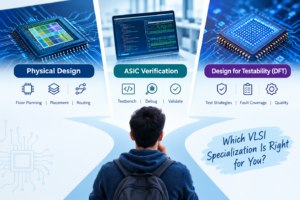
- Physical Design and Physical Verification
- ASIC Verification
- Analogue Layout Design
- Design for Test (DFT)
- RTL Coding and FPGA Design
- Analogue Circuit Design
- Scripting and EDA Tools Knowledge
Learning these skills will enable you to take part in actual chip design work and advance your career in the chip industry.
VLSI Skills That Employers Value
Nowadays, companies seek people with practical exposure rather than purely theoretical knowledge. So the highly desired VLSI skills in demand usually involve the usage of standard EDA tools in an industry setting, working on projects, and possessing problem-solving skills.
Companies often expect an engineer to:
- Understand the full cycle of chip design
- Handle timing analysis and optimization tasks
- Execute physical implementation
- Validate large digital designs
- Work alongside a variety of engineering disciplines
- Be prepared for dynamic advancements in the semiconductor industry
The Importance of Verification and UVM Knowledge
One of the fastest-growing areas within semiconductor engineering has to be design verification. As complexity continues to rise, chips must be tested prior to being made in large numbers; that’s where verification engineers come into play.
The UVM basics are a fundamental prerequisite for anyone who hopes to practice the verification techniques utilized by major semiconductor organizations. If you are proficient in verification, you will be creating testbenches, test environments, validating functionalities of the chip, etc., prior to it being released.
Career Opportunities Across the World
One of the causes that career choices in the chip sector are more in demand than before is the way the industry operates globally. There are many firms in countries like India, Taiwan, South Korea, Japan, Europe, and the United States that recruit. For individuals talented in working with chips, here are some professions they can aspire to:
- Physical Design Engineer
- ASIC Verification Engineer
- Analogue Layout Engineer
- DFT Engineer
- RTL Design Engineer
- FPGA Engineer
- Analogue Circuit Design Engineer
Preparing for the Future of Semiconductors
AI, autonomous driving, smart devices, IoT technologies, and improved communication technologies are poised to be dominant in the future of the semiconductor industry. New-age devices demand advanced microprocessors, which will guarantee future jobs in the electronics manufacturing segment. Therefore, for individuals to hold good positions in today’s job market, it will be essential to pursue training programs which update the know-how and practical experience relevant to the new technologies in electronics engineering.
Build Industry-Ready Skills with Practical Training
Only knowing how to apply some technical concepts is seldom enough to crack lucrative semiconductor job roles. Hiring companies now demand the candidate to have some practical project experience under their belt, possess awareness regarding the tools and software widely used in the industry, and have confidence gained through lab work in a practical environment.
Structured training curriculum where academic lessons are complemented by hands-on projects, mock interview rounds, and preparation for placement allows students to get prepared for the real world by narrowing down the gap between the industry and the educational system. This methodology also allows the student to become confident and appear for recruitment processes in the highly competitive sector.
Conclusion
As the international semiconductor market continues to grow, there are tremendous opportunities for engineers in this space. As companies continue to pour money into the latest technologies, the demand for people who are good in semiconductor disciplines, are practical in their application, and possess the required current VLSI skills is going to be high in almost all corners of the globe.
Takshila VLSI training focuses on preparing fresh graduates for such roles through its industry-focused training on physical design, ASIC verification, analogue layout design, DFT, analogue circuit design, RTL coding, and FPGA design. With experienced trainers, comprehensive lab practices, 24*7 access to tools, mock interviews, and active placement assistance, Takshila enables you to develop those necessary semiconductor engineering skills that the top chip design companies are looking for. Be a fresh graduate or a working professional with ambitions to scale the peaks of your career in the chip industry; Takshila gives you that platform for practical learning.