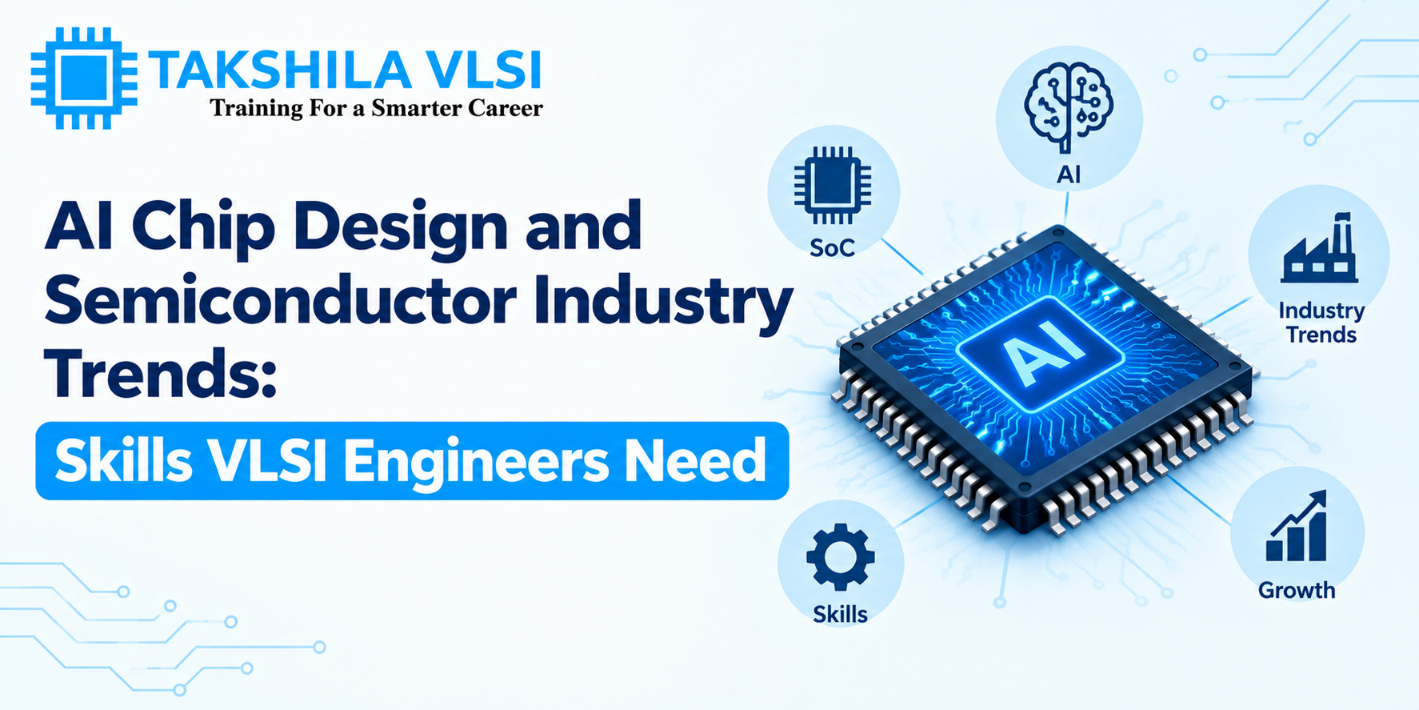
For decades, chip design followed a fairly steady rhythm: smaller transistors, higher clock speeds, and a new generation of processors every couple of years. The rise of artificial intelligence has bent that rhythm out of shape. AI workloads need enormous amounts of arithmetic and even more data movement, and conventional processors were never built for that.
The result is a wave of new hardware ideas, and with it, a new set of expectations for engineers. This article walks through the major trends in AI chip design and the semiconductor industry, and, more usefully, connects each one to the skills you can start building today.
Trend 1: AI Accelerators
An AI accelerator is a chip, or a block inside a chip, built to run neural network computations efficiently. Instead of executing instructions one at a time like a general-purpose CPU, an accelerator arranges many small multiply-accumulate units so that thousands of operations happen in parallel.
- Dataflow and systolic arrays: data pulses through a grid of processing elements, reusing values instead of fetching them repeatedly.
- Reduced precision: formats such as INT8, FP16, BF16 and newer low-precision types save area and power.
- Memory as the bottleneck: often the hard part is feeding the compute units fast enough, not building them.
- Sparsity and compression: skipping zeros and compressing weights saves bandwidth.
Skills to build: strong RTL design, pipelining, arithmetic unit design, SRAM and memory interface basics, and the ability to reason about power and area trade-offs. A good practice project is a small matrix-multiply engine written in SystemVerilog.
Trend 2: GPU Architecture
GPUs became the workhorse of AI because they apply the same operation to huge amounts of data at once. Understanding how they are organised helps even if you never design one.
- Many streaming multiprocessors, each running groups of threads in lockstep
- A deep memory hierarchy: registers, shared memory, caches and high-bandwidth external memory
- Specialised tensor or matrix units alongside general-purpose cores
- Fast interconnects that link many GPUs into a single system
Skills to build: computer architecture fundamentals, cache and memory design, parallel programming concepts and an understanding of interconnect protocols. Reading an architecture whitepaper critically is a skill in itself.
Trend 3: Chiplets and Advanced Packaging
Large monolithic chips are costly and hard to manufacture with good yield. Chiplet design splits a system into several smaller dies, each built in the process that suits it best, then joins them inside one package.
| Concept | What it means | Why it matters |
| Chiplets | Smaller dies combined in one package | Better yield, reuse and mix of technologies |
| 2.5D packaging | Dies placed side by side on a silicon interposer | Very wide, short connections, such as to HBM memory |
| 3D stacking | Dies stacked vertically | Shorter paths and more density, but thermal challenges |
| Die-to-die interfaces | Standards such as UCIe | Lets chiplets from different sources talk to each other |
Skills to build: high-speed interface concepts, signal and power integrity awareness, thermal thinking, and system-level verification. Even a physical design engineer now needs to understand what happens beyond the edge of a single die.
Trend 4: RISC-V and Customisable Processors
RISC-V is an open instruction set architecture. Because anyone can implement it without a licence fee for the ISA, companies use it to build custom processors, add their own instructions and control the full stack. It has become popular for embedded controllers, cores that manage accelerators, and research.
Skills to build: pipeline design, instruction set basics, hazard handling and verification of processor cores. Building a small RISC-V core in Verilog is one of the best portfolio projects available to a student, and verifying it is an even better one.
Trend 5: EDA Automation and AI-Assisted Design
The electronic design automation vendors are now building AI into their tools, from optimisation engines that explore design choices to agent-style assistants that can plan and run parts of a workflow. Cadence, Synopsys and Siemens have all announced agentic capabilities in 2026, with varying levels of availability and autonomy.
This does not remove the engineer. Someone still has to define the goal, judge the result and take responsibility for sign-off. What changes is the balance of work: less manual repetition, more review, specification and decision-making.
Skills to build: scripting in Python and Tcl, a firm grasp of the fundamentals so you can spot a wrong answer, and comfort with checking AI output using simulation, formal checks and synthesis. We cover this in more detail in our articles on AI in VLSI design.
Trend 6: Power and Efficiency as First-Class Goals
AI data centres consume large amounts of electricity, and edge devices run on small batteries. Both push designers to treat power as a primary goal, not an afterthought. Techniques such as clock gating, power gating, multiple voltage domains and dynamic voltage and frequency scaling are standard.
Skills to build: low-power design methodology, UPF concepts, power analysis and an appreciation for how architecture choices change energy use.
Connecting Trends to a Learning Pathway
| If you are drawn to | Start with | Then add |
| AI accelerators | Digital design, Verilog, FSMs | Pipelining, arithmetic design, memory interfaces |
| Processor design | RTL design, computer architecture | RISC-V core project, core verification |
| Chiplets and packaging | Physical design basics, STA | High-speed interfaces, power and thermal awareness |
| Verification | SystemVerilog, UVM | Formal methods, system-level and protocol verification |
| AI-assisted tools | Scripting and flow knowledge | Prompting, validation and automation skills |
Career Implications
Demand is growing for engineers who can work across boundaries: RTL and verification, design and packaging, hardware and software. Specialists remain valuable, but the engineers who understand how their piece fits into the bigger system tend to progress faster.
- Strengthen the fundamentals. Trends change; digital logic and timing do not.
- Build one depth area and two breadth areas. For example, verification as depth, with RTL and basic physical design as breadth.
- Show projects, not just course names. A small accelerator or RISC-V core says more than a list of tools.
- Keep reading. Follow vendor announcements and conference papers, but separate marketing claims from demonstrated results.
A Note of Realism
New trends bring hype. Not every chiplet idea or AI tool will become standard, and some claims will not survive real production use. Treat announcements as signals to investigate, not conclusions to repeat. The safest investment is a strong foundation plus the habit of learning continuously.
Where to Start
Pick the trend that excites you most, find the skills it needs, and begin with one small project. If you want a structured path, explore the VLSI courses and RTL design resources at Takshila Institute of VLSI Technologies, and use our career guidance pages to plan your next step.