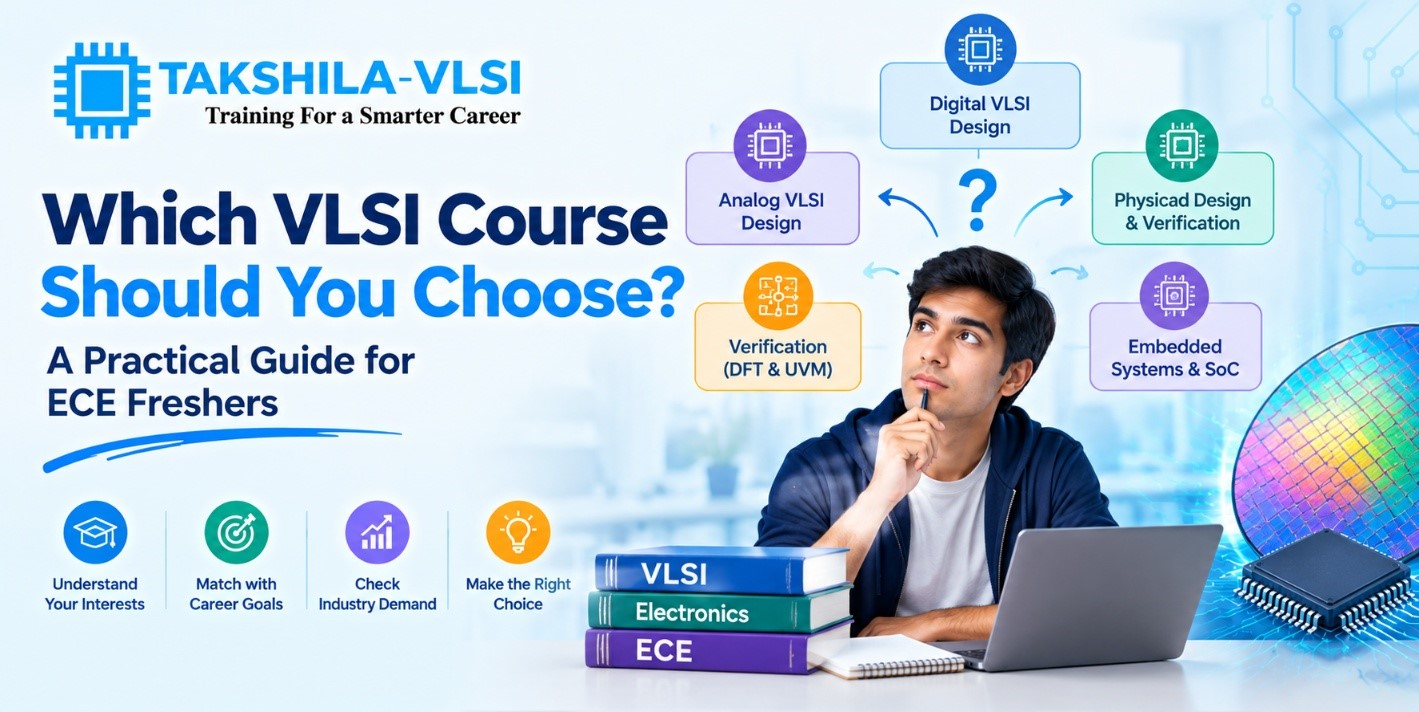
You finished your ECE degree, you know you want to work in semiconductors, and now you face a question that stops many freshers: which VLSI course should you pick? Physical design, verification, RTL design, DFT and analog layout all sound exciting, and every training institute claims theirs is the best.
The truth is that there is no single best course. There is only the course that fits your strengths, your interests and the kind of work you want to do for the next few years. This guide compares the main specializations so you can decide with clear eyes.
Start with Yourself, Not the Course
Before comparing syllabi, ask yourself a few honest questions:
- Do I enjoy writing code, or do I prefer working visually with layouts and reports?
- Am I patient with detailed, repetitive checking?
- Do I like finding bugs, or building new things from scratch?
- How strong is my background in digital electronics and analog circuits?
- Do I want to learn something broad first, or go deep into a niche?
Your answers will already point towards one or two directions.
The Five Main Specializations at a Glance
| RTL Design | Verification | Physical Design | DFT | |
| Core work | Writing synthesizable hardware code | Proving the design works | Turning a netlist into a layout | Adding test features to the chip |
| Key languages | Verilog, SystemVerilog | SystemVerilog, UVM | Tcl, Perl, Python | Tcl, Verilog |
| Strongest prerequisite | Digital design | Digital design, OOP | Digital, timing, CMOS | Digital, sequential logic |
| Main tools | Simulators, synthesis, lint | Simulators, coverage tools | P&R, STA, signoff tools | Scan and ATPG tools |
| Feels like | Architecture and coding | Detective work | Optimization puzzle | Systems and testing |
Analog layout sits slightly apart from this table because it is a custom, hand-crafted discipline. We cover it separately below.
RTL Design: For Those Who Like Building
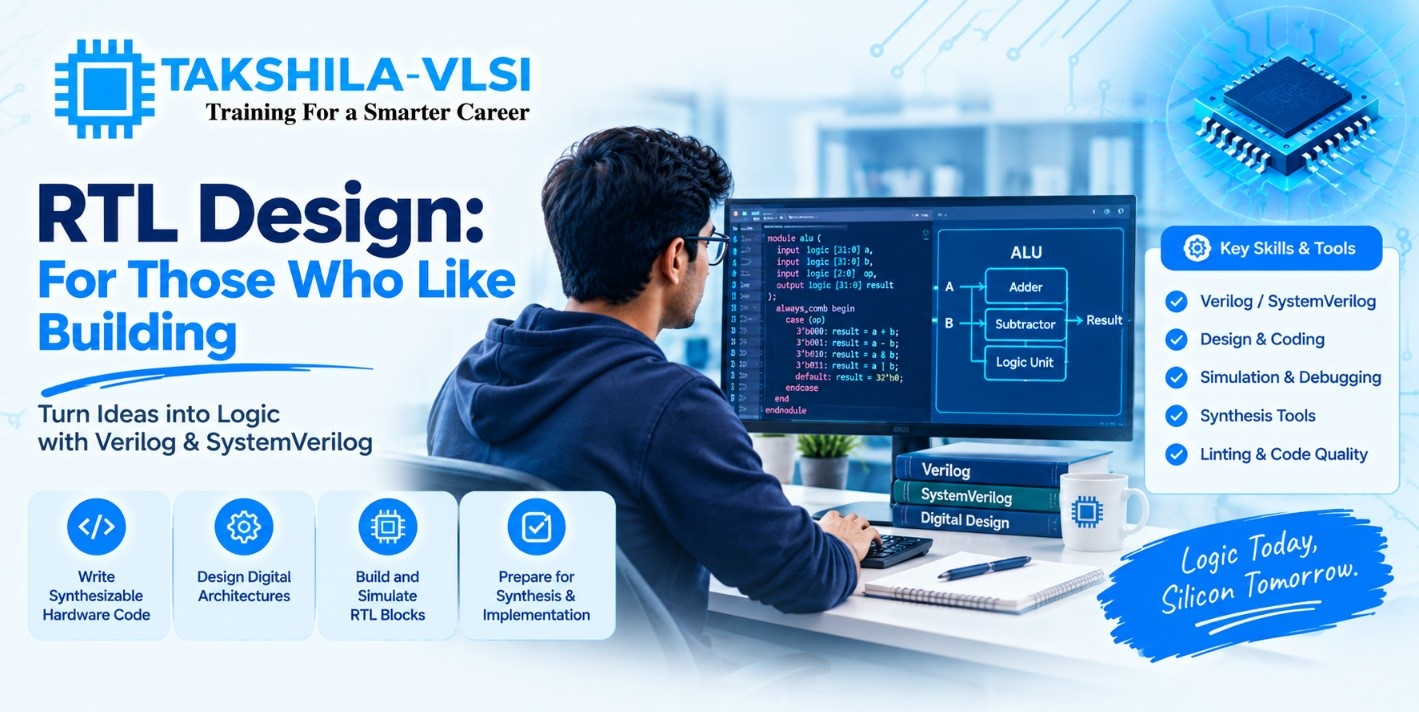
RTL engineers describe hardware behaviour in Verilog or SystemVerilog, and the result is turned into gates by synthesis. You will write finite state machines, datapaths, interfaces and control logic.
- Good fit if: you like coding, logical thinking and understanding how blocks interact.
- Daily tasks: reading specs, writing RTL, running simulation and lint, fixing synthesis issues.
- Challenge level: moderate to high. Writing code is easy; writing code that synthesizes well takes experience.
Design Verification: For the Curious Skeptic
Verification engineers try to break the design. They build testbenches in SystemVerilog and UVM, drive stimulus, check results and measure coverage.
- Good fit if: you enjoy debugging, software-style thinking and asking “what if?”
- Daily tasks: writing testbench components, creating tests, analysing failures, closing coverage.
- Challenge level: moderate at the start, rising with UVM and object-oriented concepts.
Physical Design: For the Optimizer
Physical design takes a netlist through floorplanning, placement, clock tree synthesis and routing to produce the final layout, while meeting timing, power and area goals.
- Good fit if: you enjoy puzzles with several competing constraints and you are comfortable reading detailed reports.
- Daily tasks: running tool flows, analysing timing and congestion, fixing violations, scripting.
- Challenge level: It needs a solid understanding of timing and strong scripting habits.
DFT: For the Systems Thinker
DFT engineers add scan chains, test logic and self-test features, and generate patterns used to test manufactured chips.
- Good fit if: you like seeing how a design works end to end and enjoy methodical problem solving.
- Daily tasks: scan insertion, ATPG runs, pattern debug and coverage analysis.
- Challenge level: A smaller field with fewer specialists, which can be an advantage.
Analog Layout: For the Craftsperson
Analog layout engineers draw the physical shapes for analog and mixed-signal circuits, focusing on matching, parasitics and verification.
- Good fit if: you have an eye for detail, like visual work and are comfortable with analog concepts.
- Daily tasks: device placement, routing, shielding, DRC and LVS fixing.
- Challenge level: moderate to high, and it depends heavily on how well you understand analog circuits.
Physical Design vs Verification: The Question Everyone Asks
These two are the most common choices, so here is a direct comparison.
- Mindset: verification feels closer to software engineering; physical design feels closer to engineering optimization.
- Entry barrier: verification needs strong coding and OOP comfort; physical design needs a strong grasp of timing and scripting.
- Day to day: a verification engineer spends time in waveforms and testbench code; a physical design engineer spends time in timing reports and layout views.
- Hiring: both have regular openings. Verification typically has more positions overall, while physical design roles often value hands-on tool experience.
Neither is easier. Pick the one whose daily work you would find less tiring on a Tuesday afternoon.
How to Decide: A Simple Process
- Shortlist two specializations based on the self-assessment above.
- Spend one week on a free introduction to each: write a small FSM for RTL, build a tiny testbench for verification, read a basic timing report for physical design.
- Notice which week you enjoyed more, not which one seemed easier.
- Check the curriculum for hands-on labs, project work and mentoring, not only theory.
- Ask the institute about its syllabus, tools covered and how projects are reviewed.
What to Look for in Any VLSI Course
- A syllabus that matches real industry flows
- Practical lab access to industry-standard tools
- Projects that you can explain in an interview
- Trainers with actual industry experience
- Interview preparation and feedback on your work
Final Thoughts
Many engineers change direction later, and what you learn in one specialization helps in others. A verification engineer who understands physical design is more valuable, and so is a physical design engineer who understands RTL. So choose a starting point, commit to it, and learn it well.
If you are still unsure, explore the specialization pages at Takshila Institute of VLSI Technologies and speak with the team about which path suits your background.